> ## Documentation Index
> Fetch the complete documentation index at: https://docs.orq.ai/llms.txt
> Use this file to discover all available pages before exploring further.
# GitHub Copilot
> Capture GitHub Copilot agent usage with OpenTelemetry or route Copilot Chat through the Orq.ai AI Gateway using Bring Your Own Key.
[GitHub Copilot Chat](https://code.visualstudio.com/docs/agent-customization/language-models) in VS Code supports [Bring Your Own Key (BYOK)](https://code.visualstudio.com/docs/agent-customization/language-models#_bring-your-own-language-model-key) through a **Custom Endpoint** provider. Pointing it at the **AI Gateway** routes Chat requests through **Orq.ai**, reaching the full model catalog with unified tracing, cost tracking, and access controls.
Always use the `provider/model_id` format for the model `id` value (e.g. `anthropic/claude-sonnet-5`, not `claude-sonnet-5`). Bare IDs return a `400 invalid model format` error.
## Prerequisites
* VS Code 1.122 or later (the Custom Endpoint provider graduated from Insiders to stable in this release) with the GitHub Copilot Chat extension installed
* Active **Orq.ai** account
* [Orq.ai API key](/ai-studio/organization/api-keys)
* Copilot Business or Enterprise orgs: an administrator must enable **Bring Your Own Language Model Key in VS Code** in the Copilot policy settings on GitHub.com
BYOK covers Chat and tool calls only. Inline suggestions, next-edit suggestions, and semantic search still require GitHub sign-in and are not routed through **Orq.ai**.
## Capture Copilot usage with OpenTelemetry
Copilot Chat can export agent traces using the OpenTelemetry GenAI semantic conventions. **Orq.ai** records the session hierarchy, model and token usage, tool execution, errors, conversation ID, and available repository and organization metadata. Prompt text, responses, code, tool arguments, and tool results remain excluded when content capture is disabled.
This integration covers Copilot interactions that emit OTel traces. It does not poll GitHub's aggregate Copilot metrics or audit APIs, and the public **Orq.ai** OTLP receiver ingests traces rather than Copilot's separate metrics and events.
Start an OTel Collector with an OTLP/HTTP receiver on port `4318`. Configure its trace exporter to send to `https://my.orq.ai/v2/otel` with `Authorization: Bearer `. See the [observability quickstart](/ai-studio/observability/quickstart) for the **Orq.ai** endpoint and authentication requirements.
Add these settings to VS Code:
```json theme={"theme":{"light":"github-light","dark":"github-dark"}}
{
"github.copilot.chat.otel.enabled": true,
"github.copilot.chat.otel.exporterType": "otlp-http",
"github.copilot.chat.otel.otlpEndpoint": "http://localhost:4318",
"github.copilot.chat.otel.captureContent": false
}
```
Enterprise administrators can apply the same export centrally through [Copilot managed telemetry settings](https://code.visualstudio.com/docs/agents/guides/monitoring-agents#_manage-otel-configuration-for-your-organization).
Run a Copilot agent task that calls a model and a tool. Open [**Orq.ai** Traces](/ai-studio/observability/traces) and confirm the trace shows the GitHub Copilot source, grouped conversation, model, tokens, and tool spans.
## Route Copilot Chat through the AI Gateway
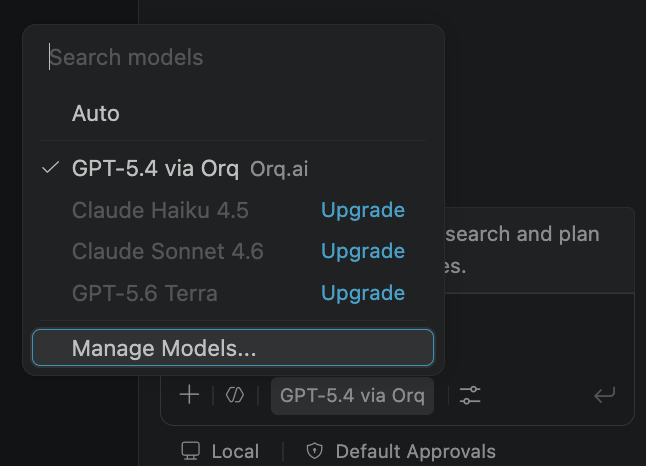
Run **Chat: Manage Language Models** from the Command Palette, or select the gear icon labeled **Manage Language Models** in the Chat model picker.
Select **Add Models**, then choose **Custom Endpoint** from the provider list. VS Code prompts for three things in sequence:
* **Group name**: any label, e.g. `Orq.ai`.
* **API key**: the **Orq.ai** [API key](/ai-studio/organization/api-keys).
* **API Type**: **Responses**, **Chat Completions**, or **Messages**, matching one of the tabs below.
VS Code then opens the global `chatLanguageModels.json` file, in the VS Code user data directory, not the project workspace, with the group already scaffolded. The API key is stored as a secret reference (`"apiKey": "${input:chat.lm.secret...}"`), not the raw key; leave that field as generated.
`chatLanguageModels.json` is an array of groups. Add an entry to the scaffolded group's `models` array:
Matches the API Type selected as **Responses**. Reaches the full **AI Gateway** catalog through **Orq.ai**'s primary API.
```json theme={"theme":{"light":"github-light","dark":"github-dark"}}
[
{
"name": "Orq.ai",
"vendor": "customendpoint",
"apiKey": "${input:chat.lm.secret...}",
"apiType": "responses",
"models": [
{
"id": "openai/gpt-5.4",
"name": "GPT-5.4 via Orq",
"url": "https://my.orq.ai/v3/router/responses",
"toolCalling": true,
"vision": true,
"maxInputTokens": 1050000,
"maxOutputTokens": 128000
}
]
}
]
```
Replace `openai/gpt-5.4` with any identifier from the **AI Gateway** catalog (e.g. `anthropic/claude-sonnet-5`, `google/gemini-3.5-flash`), and adjust `maxInputTokens`/`maxOutputTokens` to match the chosen model.
Matches the API Type selected as **Chat Completions**. Reaches the full **AI Gateway** catalog through the OpenAI-compatible router.
```json theme={"theme":{"light":"github-light","dark":"github-dark"}}
[
{
"name": "Orq.ai",
"vendor": "customendpoint",
"apiKey": "${input:chat.lm.secret...}",
"apiType": "chat-completions",
"models": [
{
"id": "openai/gpt-5.4",
"name": "GPT-5.4 via Orq",
"url": "https://my.orq.ai/v3/router/chat/completions",
"toolCalling": true,
"vision": true,
"maxInputTokens": 1050000,
"maxOutputTokens": 128000
}
]
}
]
```
Matches the API Type selected as **Messages**. Routes Claude models through the Anthropic-compatible endpoint.
```json theme={"theme":{"light":"github-light","dark":"github-dark"}}
[
{
"name": "Orq.ai Anthropic",
"vendor": "customendpoint",
"apiKey": "${input:chat.lm.secret...}",
"apiType": "messages",
"models": [
{
"id": "anthropic/claude-sonnet-5",
"name": "Claude Sonnet 5 via Orq",
"url": "https://my.orq.ai/v3/anthropic/v1/messages",
"toolCalling": true,
"vision": true,
"maxInputTokens": 200000,
"maxOutputTokens": 64000
}
]
}
]
```
Replace `anthropic/claude-sonnet-5` with any Claude identifier from the **AI Gateway** catalog.
Open the Chat model picker and select a model from the new group to start using it.
 ## Configuration Reference
`chatLanguageModels.json` is an array of provider groups.
| Field | Level | Description |
| ------------------------------------ | ----- | ------------------------------------------------------------------------------------------------------------------------------------------------------------------------------------------------ |
| `vendor` | Group | Must be `"customendpoint"` to enable BYOK. |
| `apiKey` | Group | Set automatically to a secret reference when the **Orq.ai** [API key](/ai-studio/organization/api-keys) is entered in the Add Models prompt. Do not paste the raw key here. |
| `apiType` | Group | `"responses"` for **Orq.ai**'s primary API, `"chat-completions"` for the OpenAI-compatible router, or `"messages"` for the Anthropic endpoint. |
| `id` | Model | **AI Gateway** model identifier in `provider/model_id` format. |
| `url` | Model | Full endpoint URL, not a base URL: `https://my.orq.ai/v3/router/responses`, `https://my.orq.ai/v3/router/chat/completions`, or `https://my.orq.ai/v3/anthropic/v1/messages`, matching `apiType`. |
| `toolCalling` | Model | Set to `true` for models that support function calling. |
| `vision` | Model | Set to `true` for models that accept image input. |
| `maxInputTokens` / `maxOutputTokens` | Model | Context window limits for the selected model. |
See the [Anthropic Messages API](/ai-gateway/features/anthropic-messages-api) for endpoint details, authentication, and cache\_control breakpoints.
## Skills
**Orq Skills** add pre-built agentic workflows to GitHub Copilot for the full Build, Evaluate, Optimize lifecycle.
### Installation
```bash theme={"theme":{"light":"github-light","dark":"github-dark"}}
npx skills add orq-ai/assistant-plugins --agent github-copilot
```
Set an [API key and connect the Orq MCP server](/ai-studio/integrations/code-assistants/orq-skills#prerequisites) first. Skills are then triggered by describing what is needed.
The full catalogue of skills and slash commands.
Slash commands (`/orq:quickstart`, `/orq:traces`, and others) are only available in Claude Code.
## Troubleshooting
The secret behind `apiKey` is likely wrong or expired. Reopen **Manage Language Models**, remove the group, and re-add it, pasting a valid **Orq.ai** [API key](/ai-studio/organization/api-keys) (not a GitHub, OpenAI, or Anthropic key) at the prompt.
Set the model `id` to the `provider/model_id` format (e.g. `anthropic/claude-sonnet-5`). Bare model IDs are rejected by the router.
Confirm `url` points to a full endpoint path, not just a base URL. `https://my.orq.ai/v3/router` alone is rejected; use `https://my.orq.ai/v3/router/responses` or `https://my.orq.ai/v3/router/chat/completions`.
Confirm `url` matches `apiType`: `responses` must point to `https://my.orq.ai/v3/router/responses`, `chat-completions` must point to `https://my.orq.ai/v3/router/chat/completions`, `messages` must point to `https://my.orq.ai/v3/anthropic/v1/messages`. Requests sent to the wrong endpoint will not appear in [**Orq.ai** Traces](/ai-studio/observability/traces).
BYOK only applies to Chat and tool calls. Inline suggestions, next-edit suggestions, and semantic search continue to require GitHub sign-in and are not affected by the Custom Endpoint configuration.
On a Copilot Business or Enterprise account, **Manage Language Models** does not exist as a command until an administrator enables **Bring Your Own Language Model Key in VS Code** in the Copilot policy settings on GitHub.com. The Command Palette falls back to the similarly named **Manage Language Model Access** command instead, which controls extension permissions and is unrelated to BYOK. Ask a workspace administrator to enable the policy, then reload VS Code.
The Custom Endpoint provider requires VS Code 1.122 or later; earlier versions only show built-in providers (Anthropic, Azure, Google, Ollama, OpenAI, OpenRouter, xAI). Update VS Code via **Code → Check for Updates** (macOS) or **Help → Check for Updates**, then reopen **Manage Language Models**.
Expected the first time a BYOK model is used as the active main model. Open Settings (Cmd+,), search **utility**, and set **Chat: Byok Utility Model Default** to one of the configured Custom Endpoint models.
## Verification
Select the configured model in the Chat model picker and send a message. The response appears in Copilot Chat and the trace appears in [**Orq.ai** Traces](/ai-studio/observability/traces) with the model identifier set in `id`.
## Configuration Reference
`chatLanguageModels.json` is an array of provider groups.
| Field | Level | Description |
| ------------------------------------ | ----- | ------------------------------------------------------------------------------------------------------------------------------------------------------------------------------------------------ |
| `vendor` | Group | Must be `"customendpoint"` to enable BYOK. |
| `apiKey` | Group | Set automatically to a secret reference when the **Orq.ai** [API key](/ai-studio/organization/api-keys) is entered in the Add Models prompt. Do not paste the raw key here. |
| `apiType` | Group | `"responses"` for **Orq.ai**'s primary API, `"chat-completions"` for the OpenAI-compatible router, or `"messages"` for the Anthropic endpoint. |
| `id` | Model | **AI Gateway** model identifier in `provider/model_id` format. |
| `url` | Model | Full endpoint URL, not a base URL: `https://my.orq.ai/v3/router/responses`, `https://my.orq.ai/v3/router/chat/completions`, or `https://my.orq.ai/v3/anthropic/v1/messages`, matching `apiType`. |
| `toolCalling` | Model | Set to `true` for models that support function calling. |
| `vision` | Model | Set to `true` for models that accept image input. |
| `maxInputTokens` / `maxOutputTokens` | Model | Context window limits for the selected model. |
See the [Anthropic Messages API](/ai-gateway/features/anthropic-messages-api) for endpoint details, authentication, and cache\_control breakpoints.
## Skills
**Orq Skills** add pre-built agentic workflows to GitHub Copilot for the full Build, Evaluate, Optimize lifecycle.
### Installation
```bash theme={"theme":{"light":"github-light","dark":"github-dark"}}
npx skills add orq-ai/assistant-plugins --agent github-copilot
```
Set an [API key and connect the Orq MCP server](/ai-studio/integrations/code-assistants/orq-skills#prerequisites) first. Skills are then triggered by describing what is needed.
The full catalogue of skills and slash commands.
Slash commands (`/orq:quickstart`, `/orq:traces`, and others) are only available in Claude Code.
## Troubleshooting
The secret behind `apiKey` is likely wrong or expired. Reopen **Manage Language Models**, remove the group, and re-add it, pasting a valid **Orq.ai** [API key](/ai-studio/organization/api-keys) (not a GitHub, OpenAI, or Anthropic key) at the prompt.
Set the model `id` to the `provider/model_id` format (e.g. `anthropic/claude-sonnet-5`). Bare model IDs are rejected by the router.
Confirm `url` points to a full endpoint path, not just a base URL. `https://my.orq.ai/v3/router` alone is rejected; use `https://my.orq.ai/v3/router/responses` or `https://my.orq.ai/v3/router/chat/completions`.
Confirm `url` matches `apiType`: `responses` must point to `https://my.orq.ai/v3/router/responses`, `chat-completions` must point to `https://my.orq.ai/v3/router/chat/completions`, `messages` must point to `https://my.orq.ai/v3/anthropic/v1/messages`. Requests sent to the wrong endpoint will not appear in [**Orq.ai** Traces](/ai-studio/observability/traces).
BYOK only applies to Chat and tool calls. Inline suggestions, next-edit suggestions, and semantic search continue to require GitHub sign-in and are not affected by the Custom Endpoint configuration.
On a Copilot Business or Enterprise account, **Manage Language Models** does not exist as a command until an administrator enables **Bring Your Own Language Model Key in VS Code** in the Copilot policy settings on GitHub.com. The Command Palette falls back to the similarly named **Manage Language Model Access** command instead, which controls extension permissions and is unrelated to BYOK. Ask a workspace administrator to enable the policy, then reload VS Code.
The Custom Endpoint provider requires VS Code 1.122 or later; earlier versions only show built-in providers (Anthropic, Azure, Google, Ollama, OpenAI, OpenRouter, xAI). Update VS Code via **Code → Check for Updates** (macOS) or **Help → Check for Updates**, then reopen **Manage Language Models**.
Expected the first time a BYOK model is used as the active main model. Open Settings (Cmd+,), search **utility**, and set **Chat: Byok Utility Model Default** to one of the configured Custom Endpoint models.
## Verification
Select the configured model in the Chat model picker and send a message. The response appears in Copilot Chat and the trace appears in [**Orq.ai** Traces](/ai-studio/observability/traces) with the model identifier set in `id`.