> ## Documentation Index
> Fetch the complete documentation index at: https://docs.orq.ai/llms.txt
> Use this file to discover all available pages before exploring further.
# Trace Scrubbing
> Mask selected fields in stored traces using the trace_scrubbing plugin in the AI Gateway.
The `trace_scrubbing` **plugin** selects what the **AI Gateway** writes to stored traces. It changes only the stored copy, never the live request, the response, or the payload the provider receives. See [Trace Data Masking](/docs/ai-gateway/features/security) for the per-request `security` field, which feeds the same masking.
## Use cases
* Keeping prompt content, model output, or template variables out of trace storage without changing what the model receives.
* Retaining latency, token, and cost data on a trace while removing the text that produced it.
* Enforcing one masking policy for every request in a workspace instead of adding `security.mask` to each call.
## Quick start
Add a `trace_scrubbing` entry to the `plugins` array with at least one `mask` value.
```bash cURL theme={"theme":{"light":"github-light","dark":"github-dark"}}
curl -X POST https://my.orq.ai/v3/router/chat/completions \
-H "Authorization: Bearer $ORQ_API_KEY" \
-H "Content-Type: application/json" \
-d '{
"model": "openai/gpt-5.4-mini",
"messages": [{ "role": "user", "content": "Summarize the open ticket." }],
"plugins": [{ "id": "trace_scrubbing", "mask": ["input", "output"] }]
}'
```
```typescript TypeScript theme={"theme":{"light":"github-light","dark":"github-dark"}}
import OpenAI from 'openai';
const client = new OpenAI({
apiKey: process.env.ORQ_API_KEY,
baseURL: 'https://my.orq.ai/v3/router',
});
const response = await client.chat.completions.create({
model: 'openai/gpt-5.4-mini',
messages: [{ role: 'user', content: 'Summarize the open ticket.' }],
// @ts-ignore - orq.ai extension
plugins: [{ id: 'trace_scrubbing', mask: ['input', 'output'] }],
});
```
```python Python theme={"theme":{"light":"github-light","dark":"github-dark"}}
from openai import OpenAI
import os
client = OpenAI(
api_key=os.environ.get("ORQ_API_KEY"),
base_url="https://my.orq.ai/v3/router",
)
response = client.chat.completions.create(
model="openai/gpt-5.4-mini",
messages=[{"role": "user", "content": "Summarize the open ticket."}],
extra_body={"plugins": [{"id": "trace_scrubbing", "mask": ["input", "output"]}]},
)
```
At least one `mask` value is required. The [What each value masks](/docs/ai-gateway/features/security#what-each-value-masks) table lists the accepted values and what each one removes from a stored trace.
## Enable for a workspace
Turn on **Trace Scrubbing** under **Settings** > **Plugins** to apply a mask to every request, without passing a `plugins` array on each call. Once the toggle is on, a icon appears next to it; click it to choose the surfaces to mask. Enabling the plugin without choosing any masks everything.
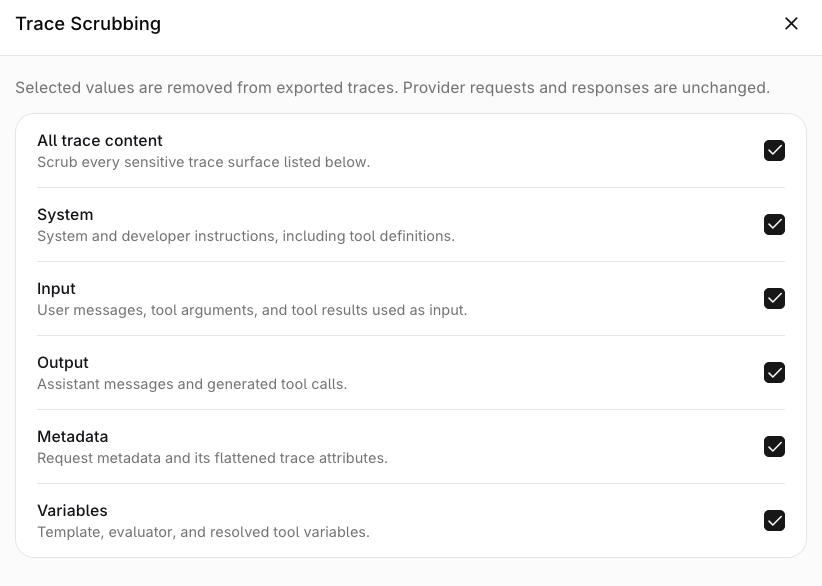 The workspace setting is a floor, not a default. The masks a request sends are added to the workspace's masks, and `all` wins over any narrower selection, so a request can mask more but never less. This matches how workspace-level [PII redaction](/docs/ai-gateway/features/plugins/pii-redaction#workspace-level-redaction) behaves.
## Apply per routing rule
Attach **Trace Scrubbing** to a [routing rule](/docs/ai-gateway/configuration/routing-rules#plugins) to mask traffic that matches the rule, with the fields chosen on the rule. An [MCP gateway](/docs/ai-gateway/mcp-portal/mcp-gateways) takes the same plugin for the tool-call traces it stores.
## Combine with security.mask
A request that carries `security.mask` has those values merged with the plugin's before the trace is written, so the two compose rather than override. The plugin is the way to mask traffic that omits `security.mask`, because only the plugin can be set for a whole workspace. See [Coverage](/docs/ai-gateway/features/security#coverage).
## What it does not do
* It does not remove anything from the live request or response, or from the payload the provider receives.
* It does not change the data an [Evaluator](/docs/ai-studio/optimize/evaluators) or Guardrail processes: the check still receives the original runtime input, output, instructions, and variables, and only the persisted span is scrubbed. See [Trace scrubbing and evaluator data](/docs/ai-studio/observability/trace-evaluations#trace-scrubbing-and-evaluator-data).
* It does not redact PII before the provider sees it. Use [PII Redaction](/docs/ai-gateway/features/plugins/pii-redaction) for that.
## Supported endpoints
The `plugins` entry is accepted on the same endpoints as the other plugins; see [Supported endpoints](/docs/ai-gateway/features/plugins/overview#supported-endpoints). The workspace setting and a routing-rule attachment reach further: their mask is written to the stored trace of any request the **AI Gateway** traces, including deployment invokes and traffic matched by a routing rule.
The workspace setting is a floor, not a default. The masks a request sends are added to the workspace's masks, and `all` wins over any narrower selection, so a request can mask more but never less. This matches how workspace-level [PII redaction](/docs/ai-gateway/features/plugins/pii-redaction#workspace-level-redaction) behaves.
## Apply per routing rule
Attach **Trace Scrubbing** to a [routing rule](/docs/ai-gateway/configuration/routing-rules#plugins) to mask traffic that matches the rule, with the fields chosen on the rule. An [MCP gateway](/docs/ai-gateway/mcp-portal/mcp-gateways) takes the same plugin for the tool-call traces it stores.
## Combine with security.mask
A request that carries `security.mask` has those values merged with the plugin's before the trace is written, so the two compose rather than override. The plugin is the way to mask traffic that omits `security.mask`, because only the plugin can be set for a whole workspace. See [Coverage](/docs/ai-gateway/features/security#coverage).
## What it does not do
* It does not remove anything from the live request or response, or from the payload the provider receives.
* It does not change the data an [Evaluator](/docs/ai-studio/optimize/evaluators) or Guardrail processes: the check still receives the original runtime input, output, instructions, and variables, and only the persisted span is scrubbed. See [Trace scrubbing and evaluator data](/docs/ai-studio/observability/trace-evaluations#trace-scrubbing-and-evaluator-data).
* It does not redact PII before the provider sees it. Use [PII Redaction](/docs/ai-gateway/features/plugins/pii-redaction) for that.
## Supported endpoints
The `plugins` entry is accepted on the same endpoints as the other plugins; see [Supported endpoints](/docs/ai-gateway/features/plugins/overview#supported-endpoints). The workspace setting and a routing-rule attachment reach further: their mask is written to the stored trace of any request the **AI Gateway** traces, including deployment invokes and traffic matched by a routing rule.