> ## Documentation Index
> Fetch the complete documentation index at: https://docs.orq.ai/llms.txt
> Use this file to discover all available pages before exploring further.
# LiteLLM
> Send LiteLLM traces to Orq.ai using OpenTelemetry instrumentation. Monitor LLM calls, costs, and latency across all providers LiteLLM supports.
Instrument your code with OpenTelemetry to capture traces, logs, and metrics for every LLM call, agent step, and tool use.
## Observability
### Getting Started
LiteLLM provides a unified interface for multiple LLM providers, enabling seamless switching between OpenAI, Anthropic, Cohere, and 100+ other providers. Tracing LiteLLM with Orq.ai gives you comprehensive insights into provider performance, cost optimization, routing decisions, and API reliability across your multi-provider setup.
### Prerequisites
Before you begin, ensure you have:
* An Orq.ai account and [API Key](/docs/administer/api-keys)
* LiteLLM installed in the project
* Python 3.8+
* API keys for the LLM providers (OpenAI, Anthropic, Cohere, etc.)
### Install Dependencies
```bash Bash theme={"theme":{"light":"github-light","dark":"github-dark"}}
pip install 'litellm[proxy]'
```
```bash Bash theme={"theme":{"light":"github-light","dark":"github-dark"}}
pip install litellm opentelemetry-sdk opentelemetry-exporter-otlp openinference-instrumentation-litellm
```
### Configure Orq.ai
Set the following environment variables to connect to the Orq.ai OpenTelemetry collector:
```bash Unix/Linux/macOS theme={"theme":{"light":"github-light","dark":"github-dark"}}
export ORQ_API_KEY=""
export OTEL_EXPORTER_OTLP_ENDPOINT="https://api.orq.ai/v2/otel/v1/traces"
export OTEL_EXPORTER_OTLP_HEADERS="Authorization=Bearer $ORQ_API_KEY"
export OTEL_RESOURCE_ATTRIBUTES="service.name=litellm-app,service.version=1.0.0"
export LITELLM_MASTER_KEY=""
# Provider API keys: add only the ones you use
export OPENAI_API_KEY=""
export ANTHROPIC_API_KEY=""
export COHERE_API_KEY=""
export GOOGLE_API_KEY=""
```
```bash Windows (PowerShell) theme={"theme":{"light":"github-light","dark":"github-dark"}}
$env:ORQ_API_KEY = ""
$env:OTEL_EXPORTER_OTLP_ENDPOINT = "https://api.orq.ai/v2/otel/v1/traces"
$env:OTEL_EXPORTER_OTLP_HEADERS = "Authorization=Bearer $env:ORQ_API_KEY"
$env:OTEL_RESOURCE_ATTRIBUTES = "service.name=litellm-app,service.version=1.0.0"
$env:LITELLM_MASTER_KEY = ""
# Provider API keys: add only the ones you use
$env:OPENAI_API_KEY = ""
$env:ANTHROPIC_API_KEY = ""
$env:COHERE_API_KEY = ""
$env:GOOGLE_API_KEY = ""
```
```bash .env theme={"theme":{"light":"github-light","dark":"github-dark"}}
ORQ_API_KEY=
OTEL_EXPORTER_OTLP_ENDPOINT=https://api.orq.ai/v2/otel/v1/traces
OTEL_EXPORTER_OTLP_HEADERS=Authorization=Bearer
OTEL_RESOURCE_ATTRIBUTES=service.name=litellm-app,service.version=1.0.0
LITELLM_MASTER_KEY=
# Provider API keys: add only the ones you use
OPENAI_API_KEY=
ANTHROPIC_API_KEY=
COHERE_API_KEY=
GOOGLE_API_KEY=
```
### Integrations
`litellm.callbacks = ["otel"]` only emits spans when running inside **LiteLLM Proxy Server**. In a standalone Python script it logs a warning and skips OTel initialisation. No spans reach **Orq.ai**. Choose the setup that matches the environment below.
Run the LiteLLM Proxy Server with the `otel` callback enabled. The proxy handles all OTel export using the environment variables configured above.
```yaml config.yaml theme={"theme":{"light":"github-light","dark":"github-dark"}}
model_list:
- model_name: gpt-4o
litellm_params:
model: openai/gpt-4o
api_key: os.environ/OPENAI_API_KEY
litellm_settings:
callbacks: ["otel"]
router_settings:
pass_through_all_models: true
general_settings:
master_key: os.environ/LITELLM_MASTER_KEY
```
```bash Bash theme={"theme":{"light":"github-light","dark":"github-dark"}}
litellm --config config.yaml
```
```python Python theme={"theme":{"light":"github-light","dark":"github-dark"}}
from openai import OpenAI
import os
client = OpenAI(
base_url="http://localhost:4000",
api_key=os.getenv("LITELLM_MASTER_KEY"),
)
response = client.chat.completions.create(
model="gpt-4o",
messages=[{"role": "user", "content": "Hello, how are you?"}],
)
print(response.choices[0].message.content)
```
Use `openinference-instrumentation-litellm` for automatic OpenTelemetry tracing without running a proxy:
```python Python theme={"theme":{"light":"github-light","dark":"github-dark"}}
from opentelemetry.exporter.otlp.proto.http.trace_exporter import OTLPSpanExporter
from opentelemetry.sdk.resources import Resource
from opentelemetry.sdk.trace import TracerProvider
from opentelemetry.sdk.trace.export import BatchSpanProcessor
from openinference.instrumentation.litellm import LiteLLMInstrumentor
import litellm
import os
tracer_provider = TracerProvider(
resource=Resource({"service.name": "litellm-app"})
)
otlp_exporter = OTLPSpanExporter(
endpoint=os.getenv("OTEL_EXPORTER_OTLP_ENDPOINT"),
headers={"Authorization": f"Bearer {os.getenv('ORQ_API_KEY')}"},
)
tracer_provider.add_span_processor(BatchSpanProcessor(otlp_exporter))
LiteLLMInstrumentor().instrument(tracer_provider=tracer_provider)
response = litellm.completion(
model="gpt-4o",
messages=[{"role": "user", "content": "Hello, how are you?"}],
)
print(response.choices[0].message.content)
```
All LiteLLM calls will be automatically instrumented and exported to **Orq.ai** through the OTLP exporter. For more details, see [Traces](/docs/observability/traces).
### Examples
**Basic Multi-Provider Usage**
```python Python theme={"theme":{"light":"github-light","dark":"github-dark"}}
from openai import OpenAI
import os
client = OpenAI(
base_url="http://localhost:4000",
api_key=os.getenv("LITELLM_MASTER_KEY"),
)
def basic_multi_provider_example():
models = [
"gpt-4o",
"claude-opus-4-7",
"command-r",
"gemini/gemini-2.0-flash",
"ollama/llama3.2",
]
prompt = "Explain the benefits of microservices architecture in 2 sentences."
results = []
for model in models:
try:
print(f"Testing {model}...")
response = client.chat.completions.create(
model=model,
messages=[{"role": "user", "content": prompt}],
max_tokens=150,
temperature=0.7,
)
results.append({
"model": model,
"content": response.choices[0].message.content,
"tokens": response.usage.total_tokens,
"cost": response.usage.total_tokens * 0.002,
})
except Exception as e:
print(f"Error with {model}: {e}")
results.append({"model": model, "error": str(e)})
return results
results = basic_multi_provider_example()
for result in results:
if "error" not in result:
print(f"{result['model']}: {result['tokens']} tokens, ~${result['cost']:.4f}")
```
```python Python theme={"theme":{"light":"github-light","dark":"github-dark"}}
from opentelemetry.exporter.otlp.proto.http.trace_exporter import OTLPSpanExporter
from opentelemetry.sdk.resources import Resource
from opentelemetry.sdk.trace import TracerProvider
from opentelemetry.sdk.trace.export import BatchSpanProcessor
from openinference.instrumentation.litellm import LiteLLMInstrumentor
import litellm
import os
tracer_provider = TracerProvider(
resource=Resource({"service.name": "litellm-app"})
)
otlp_exporter = OTLPSpanExporter(
endpoint=os.getenv("OTEL_EXPORTER_OTLP_ENDPOINT"),
headers={"Authorization": f"Bearer {os.getenv('ORQ_API_KEY')}"},
)
tracer_provider.add_span_processor(BatchSpanProcessor(otlp_exporter))
LiteLLMInstrumentor().instrument(tracer_provider=tracer_provider)
def basic_multi_provider_example():
models = [
"gpt-4o",
"claude-opus-4-7",
"command-r",
"gemini/gemini-2.0-flash",
"ollama/llama3.2",
]
prompt = "Explain the benefits of microservices architecture in 2 sentences."
results = []
for model in models:
try:
print(f"Testing {model}...")
response = litellm.completion(
model=model,
messages=[{"role": "user", "content": prompt}],
max_tokens=150,
temperature=0.7,
)
results.append({
"model": model,
"content": response.choices[0].message.content,
"tokens": response.usage.total_tokens,
"cost": response.usage.total_tokens * 0.002,
})
except Exception as e:
print(f"Error with {model}: {e}")
results.append({"model": model, "error": str(e)})
return results
results = basic_multi_provider_example()
for result in results:
if "error" not in result:
print(f"{result['model']}: {result['tokens']} tokens, ~${result['cost']:.4f}")
```
**Cost Optimization with Provider Fallback**
```python Python theme={"theme":{"light":"github-light","dark":"github-dark"}}
from openai import OpenAI
from typing import List, Dict, Any
import os
client = OpenAI(
base_url="http://localhost:4000",
api_key=os.getenv("LITELLM_MASTER_KEY"),
)
def cost_optimized_completion(
messages: List[Dict[str, str]],
fallback_models: List[str] = None,
max_tokens: int = 100,
) -> Dict[str, Any]:
if fallback_models is None:
fallback_models = [
"gpt-4o-mini",
"claude-haiku-4-5",
"command",
"gpt-4o",
"claude-sonnet-4-6",
]
for i, model in enumerate(fallback_models):
try:
print(f"Attempting {model} (priority {i+1})...")
response = client.chat.completions.create(
model=model,
messages=messages,
max_tokens=max_tokens,
temperature=0.7,
)
# approximate values: check provider pricing pages for current rates
cost_per_1k_tokens = {
"gpt-4o-mini": 0.0015,
"gpt-4o": 0.005,
"claude-haiku-4-5": 0.00025,
"claude-sonnet-4-6": 0.003,
"command": 0.015,
}
estimated_cost = (response.usage.total_tokens / 1000) * cost_per_1k_tokens.get(model, 0.002)
return {
"success": True,
"model_used": model,
"content": response.choices[0].message.content,
"tokens": response.usage.total_tokens,
"estimated_cost": estimated_cost,
"attempt_number": i + 1,
}
except Exception as e:
print(f"Failed with {model}: {e}")
if i == len(fallback_models) - 1:
return {
"success": False,
"error": f"All models failed. Last error: {e}",
"attempts": len(fallback_models),
}
continue
return {"success": False, "error": "No models available"}
result = cost_optimized_completion([
{"role": "user", "content": "Summarize the key benefits of using Docker containers for development"}
])
if result["success"]:
print(f"Success with {result['model_used']} on attempt {result['attempt_number']}")
print(f"Cost: ~${result['estimated_cost']:.4f}, Tokens: {result['tokens']}")
print(f"Response: {result['content'][:100]}...")
```
```python Python theme={"theme":{"light":"github-light","dark":"github-dark"}}
from opentelemetry.exporter.otlp.proto.http.trace_exporter import OTLPSpanExporter
from opentelemetry.sdk.resources import Resource
from opentelemetry.sdk.trace import TracerProvider
from opentelemetry.sdk.trace.export import BatchSpanProcessor
from openinference.instrumentation.litellm import LiteLLMInstrumentor
import litellm
from typing import List, Dict, Any
import os
tracer_provider = TracerProvider(
resource=Resource({"service.name": "litellm-app"})
)
otlp_exporter = OTLPSpanExporter(
endpoint=os.getenv("OTEL_EXPORTER_OTLP_ENDPOINT"),
headers={"Authorization": f"Bearer {os.getenv('ORQ_API_KEY')}"},
)
tracer_provider.add_span_processor(BatchSpanProcessor(otlp_exporter))
LiteLLMInstrumentor().instrument(tracer_provider=tracer_provider)
def cost_optimized_completion(
messages: List[Dict[str, str]],
fallback_models: List[str] = None,
max_tokens: int = 100,
) -> Dict[str, Any]:
if fallback_models is None:
fallback_models = [
"gpt-4o-mini",
"claude-haiku-4-5",
"command",
"gpt-4o",
"claude-sonnet-4-6",
]
for i, model in enumerate(fallback_models):
try:
print(f"Attempting {model} (priority {i+1})...")
response = litellm.completion(
model=model,
messages=messages,
max_tokens=max_tokens,
temperature=0.7,
)
# approximate values: check provider pricing pages for current rates
cost_per_1k_tokens = {
"gpt-4o-mini": 0.0015,
"gpt-4o": 0.005,
"claude-haiku-4-5": 0.00025,
"claude-sonnet-4-6": 0.003,
"command": 0.015,
}
estimated_cost = (response.usage.total_tokens / 1000) * cost_per_1k_tokens.get(model, 0.002)
return {
"success": True,
"model_used": model,
"content": response.choices[0].message.content,
"tokens": response.usage.total_tokens,
"estimated_cost": estimated_cost,
"attempt_number": i + 1,
}
except Exception as e:
print(f"Failed with {model}: {e}")
if i == len(fallback_models) - 1:
return {
"success": False,
"error": f"All models failed. Last error: {e}",
"attempts": len(fallback_models),
}
continue
return {"success": False, "error": "No models available"}
result = cost_optimized_completion([
{"role": "user", "content": "Summarize the key benefits of using Docker containers for development"}
])
if result["success"]:
print(f"Success with {result['model_used']} on attempt {result['attempt_number']}")
print(f"Cost: ~${result['estimated_cost']:.4f}, Tokens: {result['tokens']}")
print(f"Response: {result['content'][:100]}...")
```
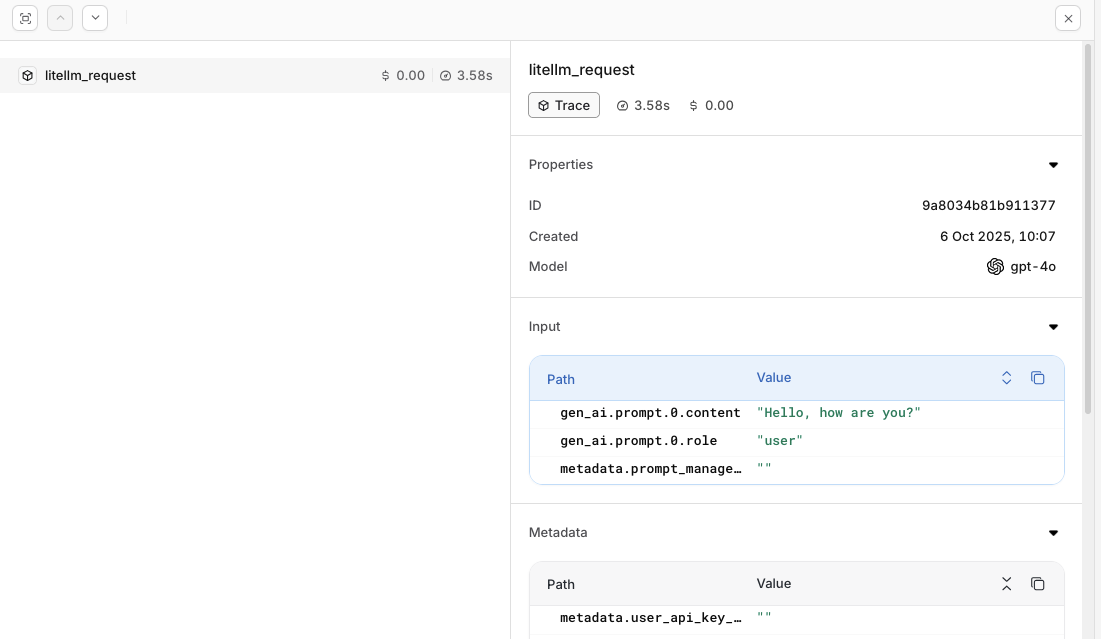
### View Traces
Head to the [Traces](/docs/observability/traces) tab to view LiteLLM traces in the AI Studio.
 ## Evaluations & Experiments
Once your agents are running, use **Evaluatorq** to score outputs across a dataset and **Experiments** to compare configurations side-by-side.
Run parallel evaluations across your agents and compare results.
Compare agent configurations and view results in the AI Studio.
## Evaluations & Experiments
Once your agents are running, use **Evaluatorq** to score outputs across a dataset and **Experiments** to compare configurations side-by-side.
Run parallel evaluations across your agents and compare results.
Compare agent configurations and view results in the AI Studio.