> ## Documentation Index
> Fetch the complete documentation index at: https://docs.orq.ai/llms.txt
> Use this file to discover all available pages before exploring further.
# Annotation Queues
> Curate production traces into high-quality evaluation datasets. Apply human feedback, labels, and corrections to build the test cases that power systematic improvement.
After observing an application in production, the next step is annotating and curating that data to build evaluation datasets. This process turns raw production logs into high-quality test cases that drive systematic improvement.
**Use Cases**
Capture thumbs up/down ratings, custom scores, or categorical labels on AI responses. Build a feedback loop that surfaces low-quality generations for review.
Flag responses with specific defects (hallucination, off-topic, inappropriate content) using structured annotation keys shared across the team.
Annotate Traces with corrections and quality labels, then export curated subsets as training datasets for future experiments.
Route Traces to Annotation Queues for systematic expert review. Combine with Trace Automations to automatically surface Traces that meet specific criteria.
**Concepts**
Three concepts work together to form the annotations system:
* **Human Reviews**: define the schema (key, value type, options) that annotations must conform to
* **Annotation Queues**: organized workflows for reviewing Traces in bulk via **AI Studio**
* **Annotations API**: the API and SDK for applying feedback values to a Trace or span programmatically
Define annotation schemas: keys, value types, and validation rules. Available on chat completion and responses spans once created.
Organize human review workflows. Filter and present relevant Traces for review in bulk.
Apply structured human feedback to Traces and spans programmatically via the API and SDK.
## Create Human Review
Human Reviews define the structure and validation rules for annotations. Each annotation key must match an existing Human Review definition in the project.
To create a Human Review, head to **Project Settings > Human Review** and press the button. Human Reviews can also be created directly from an [Annotation Queue](#use-annotation-queues).
 Three Human Review types are available:
* **Categorical**: button options with custom labels, such as good/bad or saved/deleted
* **Range**: a custom scoring slider, for example a scale from 0 to 100
* **Open field**: free-form text input for detailed comments
Once created, a Human Review is available on all chat completion spans and responses spans in the project. No additional configuration or filtering required.
Deleting a Human Review removes it from any Annotation Queues and Experiments that use it, so it no longer appears as a review option there. Annotations already recorded with that Human Review are preserved: every annotated data point remains stored and queryable.
### Common Annotation Types Legacy
Rate the overall quality of AI responses:
| Rating | Description |
| -------- | ----------------------------------------- |
| **good** | The response was helpful and accurate. |
| **bad** | The response was unhelpful or inaccurate. |
Identify specific issues with AI responses:
| Defect | Description |
| ------------------ | ------------------------------------------------------------- |
| **grammatical** | Responses that contain grammatical errors |
| **spelling** | Responses that contain spelling errors |
| **hallucination** | Responses that contain hallucinations or factual inaccuracies |
| **repetition** | Responses that contain unnecessary repetition |
| **inappropriate** | Responses that are deemed inappropriate or offensive |
| **off\_topic** | Responses that do not address the user's query |
| **incompleteness** | Responses that are incomplete or partially address the query |
| **ambiguity** | Responses that are vague or unclear |
Multiple defects can be selected for one response using an array-type Human Review.
## Use Annotations
Annotations can be applied wherever a Trace or span is reviewed:
* **Directly on a Trace or Log**: open a single Trace or Log in the [Traces](/docs/ai-studio/observability/traces) or [Logs](/docs/ai-studio/observability/logs) view and use the **Annotations** panel.
* **In an [Annotation Queue](#use-annotation-queues)**: review a curated set of Traces in bulk. Fill a queue with [Trace Automations](/docs/ai-studio/observability/automations) or by manually adding individual Traces or Logs.
* **Programmatically**: apply feedback through the API and SDK using the **API & SDK** tab below.
* **In an [Experiment](#annotations-in-experiments)**: apply Human Reviews while reviewing experiment outputs.
Every annotation applied in an Annotation Queue is written back to its originating Trace. Because the values live on the Trace, they can be queried with the [**Orq MCP**](/docs/ai-studio/get-started/orq-mcp) and used to run analysis across reviewed data.
The annotation capabilities differ between [Logs](/docs/ai-studio/observability/logs) and [Traces](/docs/ai-studio/observability/traces). Logs support both human feedback and corrections, while Traces only support human feedback annotations.
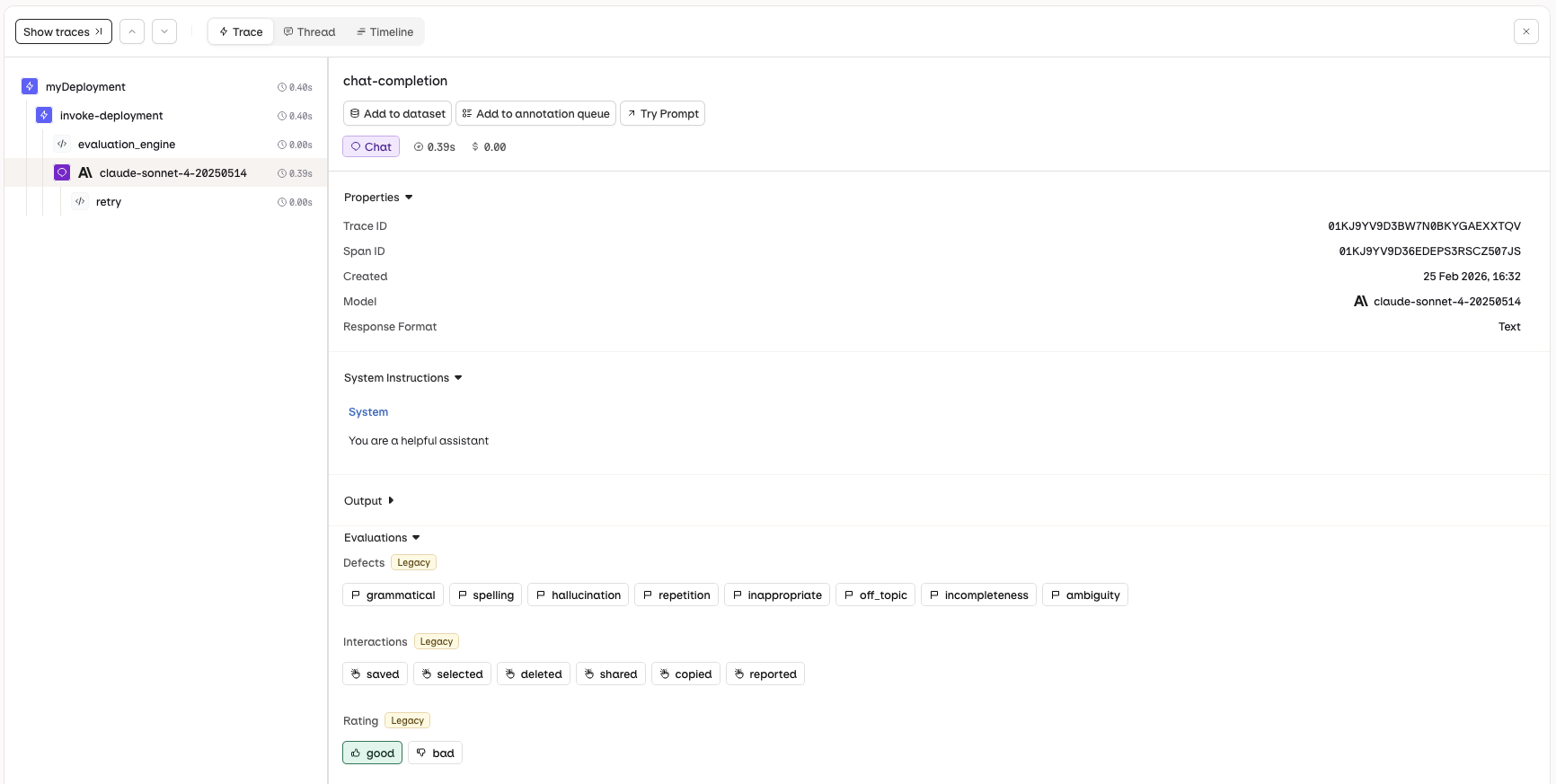
Navigate to the [Traces](/docs/ai-studio/observability/traces) view and select a single trace. The **Annotations** panel will be displayed, allowing you to apply human feedback to the AI response.
Three Human Review types are available:
* **Categorical**: button options with custom labels, such as good/bad or saved/deleted
* **Range**: a custom scoring slider, for example a scale from 0 to 100
* **Open field**: free-form text input for detailed comments
Once created, a Human Review is available on all chat completion spans and responses spans in the project. No additional configuration or filtering required.
Deleting a Human Review removes it from any Annotation Queues and Experiments that use it, so it no longer appears as a review option there. Annotations already recorded with that Human Review are preserved: every annotated data point remains stored and queryable.
### Common Annotation Types Legacy
Rate the overall quality of AI responses:
| Rating | Description |
| -------- | ----------------------------------------- |
| **good** | The response was helpful and accurate. |
| **bad** | The response was unhelpful or inaccurate. |
Identify specific issues with AI responses:
| Defect | Description |
| ------------------ | ------------------------------------------------------------- |
| **grammatical** | Responses that contain grammatical errors |
| **spelling** | Responses that contain spelling errors |
| **hallucination** | Responses that contain hallucinations or factual inaccuracies |
| **repetition** | Responses that contain unnecessary repetition |
| **inappropriate** | Responses that are deemed inappropriate or offensive |
| **off\_topic** | Responses that do not address the user's query |
| **incompleteness** | Responses that are incomplete or partially address the query |
| **ambiguity** | Responses that are vague or unclear |
Multiple defects can be selected for one response using an array-type Human Review.
## Use Annotations
Annotations can be applied wherever a Trace or span is reviewed:
* **Directly on a Trace or Log**: open a single Trace or Log in the [Traces](/docs/ai-studio/observability/traces) or [Logs](/docs/ai-studio/observability/logs) view and use the **Annotations** panel.
* **In an [Annotation Queue](#use-annotation-queues)**: review a curated set of Traces in bulk. Fill a queue with [Trace Automations](/docs/ai-studio/observability/automations) or by manually adding individual Traces or Logs.
* **Programmatically**: apply feedback through the API and SDK using the **API & SDK** tab below.
* **In an [Experiment](#annotations-in-experiments)**: apply Human Reviews while reviewing experiment outputs.
Every annotation applied in an Annotation Queue is written back to its originating Trace. Because the values live on the Trace, they can be queried with the [**Orq MCP**](/docs/ai-studio/get-started/orq-mcp) and used to run analysis across reviewed data.
The annotation capabilities differ between [Logs](/docs/ai-studio/observability/logs) and [Traces](/docs/ai-studio/observability/traces). Logs support both human feedback and corrections, while Traces only support human feedback annotations.
Navigate to the [Traces](/docs/ai-studio/observability/traces) view and select a single trace. The **Annotations** panel will be displayed, allowing you to apply human feedback to the AI response.
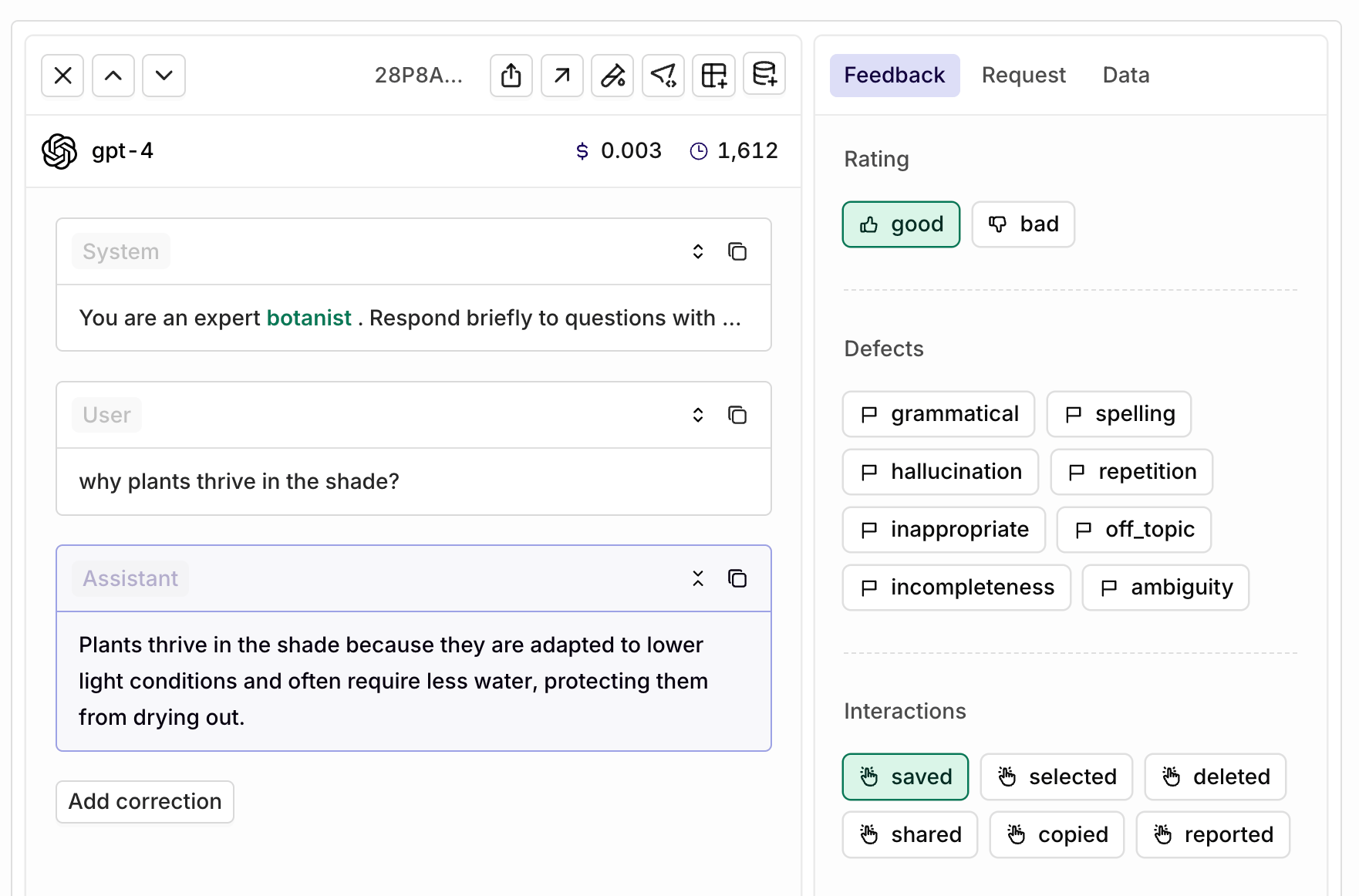
 Navigate to the [Logs](/docs/ai-studio/observability/logs) view and select a single log. The **Annotations** panel will be displayed, allowing you to apply human feedback and provide corrections to the AI response.
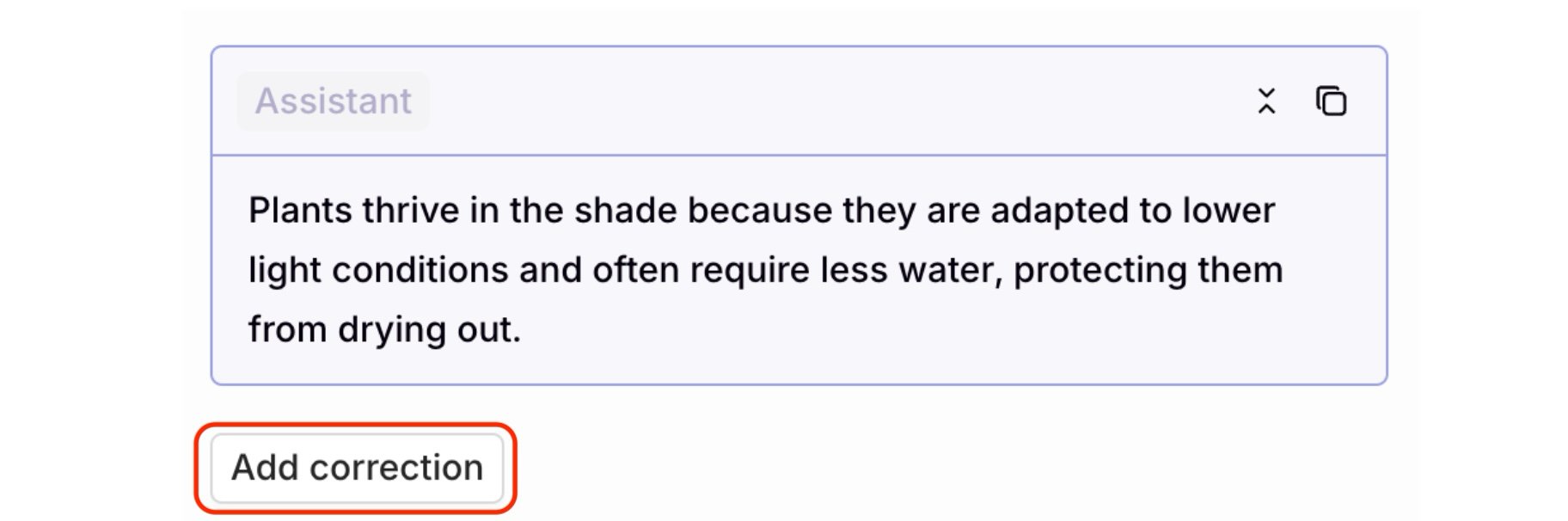
 To make a correction, use the **Add correction** button below the AI-generated response:
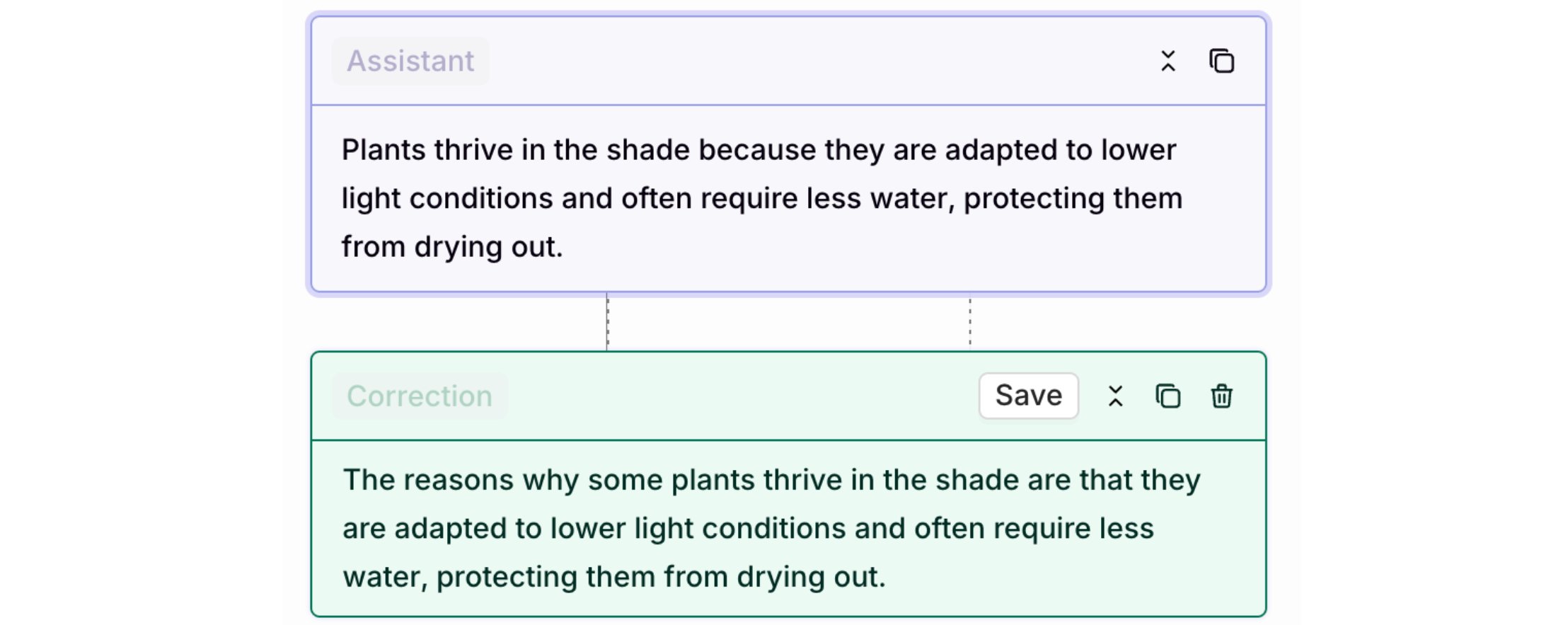
 Click to add a correction, which opens an editor for manually revising the model's response. Select **Save** to store the correction.
 Corrections are valuable for building curated datasets. Learn more in [Creating a Curated Dataset](/docs/datasets/creating).
Here are examples on how to use the API to annotate LLM responses.
```bash cURL theme={"theme":{"light":"github-light","dark":"github-dark"}}
curl -X POST "https://api.orq.ai/v2/traces/{trace_id}/spans/{span_id}/annotation" \
-H "Authorization: Bearer $ORQ_API_KEY" \
-H "Content-Type: application/json" \
-d '{
"annotations": [
{
"key": "rating",
"value": "good"
}
]
}'
```
```python Python theme={"theme":{"light":"github-light","dark":"github-dark"}}
from orq_ai_sdk import Orq
import os
orq = Orq(api_key=os.getenv("ORQ_API_KEY"))
result = orq.annotations.create(
trace_id="",
span_id="",
annotations=[
{
"key": "rating",
"value": "good"
}
]
)
print(result)
```
```typescript TypeScript theme={"theme":{"light":"github-light","dark":"github-dark"}}
import { Orq } from "@orq-ai/node";
const orq = new Orq({
apiKey: process.env.ORQ_API_KEY,
});
const result = await orq.annotations.create({
traceId: "",
spanId: "",
annotations: [
{
key: "rating",
value: "good"
}
]
});
console.log(result);
```
```bash cURL theme={"theme":{"light":"github-light","dark":"github-dark"}}
curl -X POST "https://api.orq.ai/v2/traces/{trace_id}/spans/{span_id}/annotation" \
-H "Authorization: Bearer $ORQ_API_KEY" \
-H "Content-Type: application/json" \
-d '{
"annotations": [
{
"key": "defects",
"value": ["grammatical", "spelling", "ambiguity"]
}
]
}'
```
```python Python theme={"theme":{"light":"github-light","dark":"github-dark"}}
from orq_ai_sdk import Orq
import os
orq = Orq(api_key=os.getenv("ORQ_API_KEY"))
result = orq.annotations.create(
trace_id="",
span_id="",
annotations=[
{
"key": "defects",
"value": ["grammatical", "spelling", "ambiguity"]
}
]
)
print(result)
```
```typescript TypeScript theme={"theme":{"light":"github-light","dark":"github-dark"}}
import { Orq } from "@orq-ai/node";
const orq = new Orq({
apiKey: process.env.ORQ_API_KEY,
});
const result = await orq.annotations.create({
traceId: "",
spanId: "",
annotations: [
{
key: "defects",
value: ["grammatical", "spelling", "ambiguity"]
}
]
});
console.log(result);
```
```bash cURL theme={"theme":{"light":"github-light","dark":"github-dark"}}
curl -X POST "https://api.orq.ai/v2/traces/{trace_id}/spans/{span_id}/annotation" \
-H "Authorization: Bearer $ORQ_API_KEY" \
-H "Content-Type: application/json" \
-d '{
"annotations": [
{
"key": "confidence_score",
"value": 0.95
}
],
"metadata": {
"identityId": "user-123"
}
}'
```
```python Python theme={"theme":{"light":"github-light","dark":"github-dark"}}
from orq_ai_sdk import Orq
import os
orq = Orq(api_key=os.getenv("ORQ_API_KEY"))
result = orq.annotations.create(
trace_id="",
span_id="",
annotations=[
{
"key": "confidence_score",
"value": 0.95
}
],
metadata={
"identityId": "user-123"
}
)
print(result)
```
```typescript TypeScript theme={"theme":{"light":"github-light","dark":"github-dark"}}
import { Orq } from "@orq-ai/node";
const orq = new Orq({
apiKey: process.env.ORQ_API_KEY,
});
const result = await orq.annotations.create({
traceId: "",
spanId: "",
annotations: [
{
key: "confidence_score",
value: 0.95
}
],
metadata: {
identityId: "user-123"
}
});
console.log(result);
```
```bash cURL theme={"theme":{"light":"github-light","dark":"github-dark"}}
curl -X POST "https://api.orq.ai/v2/traces/{trace_id}/spans/{span_id}/annotation" \
-H "Authorization: Bearer $ORQ_API_KEY" \
-H "Content-Type: application/json" \
-d '{
"annotations": [
{
"key": "correction",
"value": "The correct answer should emphasize scalability and fault tolerance."
}
]
}'
```
```python Python theme={"theme":{"light":"github-light","dark":"github-dark"}}
from orq_ai_sdk import Orq
import os
orq = Orq(api_key=os.getenv("ORQ_API_KEY"))
result = orq.annotations.create(
trace_id="",
span_id="",
annotations=[
{
"key": "correction",
"value": "The correct answer should emphasize scalability and fault tolerance."
}
]
)
print(result)
```
```typescript TypeScript theme={"theme":{"light":"github-light","dark":"github-dark"}}
import { Orq } from "@orq-ai/node";
const orq = new Orq({
apiKey: process.env.ORQ_API_KEY,
});
const result = await orq.annotations.create({
traceId: "",
spanId: "",
annotations: [
{
key: "correction",
value: "The correct answer should emphasize scalability and fault tolerance."
}
]
});
console.log(result);
```
```bash cURL theme={"theme":{"light":"github-light","dark":"github-dark"}}
curl -X POST "https://api.orq.ai/v2/traces/{trace_id}/spans/{span_id}/annotation" \
-H "Authorization: Bearer $ORQ_API_KEY" \
-H "Content-Type: application/json" \
-d '{
"annotations": [
{
"key": "rating",
"value": "good"
},
{
"key": "confidence_score",
"value": 0.92
},
{
"key": "categories",
"value": ["helpful", "accurate", "concise"]
}
]
}'
```
```python Python theme={"theme":{"light":"github-light","dark":"github-dark"}}
from orq_ai_sdk import Orq
import os
orq = Orq(api_key=os.getenv("ORQ_API_KEY"))
result = orq.annotations.create(
trace_id="",
span_id="",
annotations=[
{"key": "rating", "value": "good"},
{"key": "confidence_score", "value": 0.92},
{"key": "categories", "value": ["helpful", "accurate", "concise"]}
]
)
print(result)
```
```typescript TypeScript theme={"theme":{"light":"github-light","dark":"github-dark"}}
import { Orq } from "@orq-ai/node";
const orq = new Orq({
apiKey: process.env.ORQ_API_KEY,
});
const result = await orq.annotations.create({
traceId: "",
spanId: "",
annotations: [
{ key: "rating", value: "good" },
{ key: "confidence_score", value: 0.92 },
{ key: "categories", value: ["helpful", "accurate", "concise"] }
]
});
console.log(result);
```
```bash cURL theme={"theme":{"light":"github-light","dark":"github-dark"}}
curl -X DELETE "https://api.orq.ai/v2/traces/{trace_id}/spans/{span_id}/annotation" \
-H "Authorization: Bearer $ORQ_API_KEY" \
-H "Content-Type: application/json" \
-d '{
"keys": ["rating", "defects"]
}'
```
```python Python theme={"theme":{"light":"github-light","dark":"github-dark"}}
from orq_ai_sdk import Orq
import os
orq = Orq(api_key=os.getenv("ORQ_API_KEY"))
result = orq.annotations.delete(
trace_id="",
span_id="",
keys=["rating", "defects"]
)
print(result)
```
```typescript TypeScript theme={"theme":{"light":"github-light","dark":"github-dark"}}
import { Orq } from "@orq-ai/node";
const orq = new Orq({
apiKey: process.env.ORQ_API_KEY,
});
const result = await orq.annotations.delete({
traceId: "",
spanId: "",
keys: ["rating", "defects"]
});
console.log(result);
```
**API Error Handling**
| Status Code | Error | Example Message | Solution |
| ----------- | ---------------------- | ------------------------------------------------------------------------ | ---------------------------------------------------------------------------- |
| **404** | Human Review Not Found | `The human review with key "rating" for workspace abc123 was not found.` | Create a Human Review with the specified key before annotating. |
| **404** | Span Not Found | `Span with id xyz789 for workspace abc123 was not found.` | Verify the `trace_id` and `span_id` are correct and belong to the workspace. |
| **400** | Invalid Value | `Invalid value: poor. Valid options are: good, bad.` | Ensure the value matches the options defined in the Human Review. |
| **400** | Value Out of Range | `Value 15 is out of range [0, 10].` | Provide a number within the defined min/max range for the Human Review. |
| **400** | String Too Long | `String value exceeds maximum length of 200 characters.` | Shorten the string annotation to 200 characters or less. |
See a complete feedback loop implemented from scratch. Read our cookbook [Capturing User Feedback](/docs/tutorials/capturing-feedback-with-orq).
**Constraints**
* **Batch Limits**: up to 10 annotations per create request, up to 10 keys per delete request
* **String Length**: string values are limited to 200 characters maximum
* **Deployment Span Propagation**: when annotating a deployment span, the associated log is automatically annotated with the same values
* **Metadata Fields**: optional `metadata` object supports `identityId`, `source`, and `reviewerId` for tracking and attribution
## Create Annotation Queues
Annotation Queues help you organize and apply Human Reviews effectively to relevant incoming Traces.
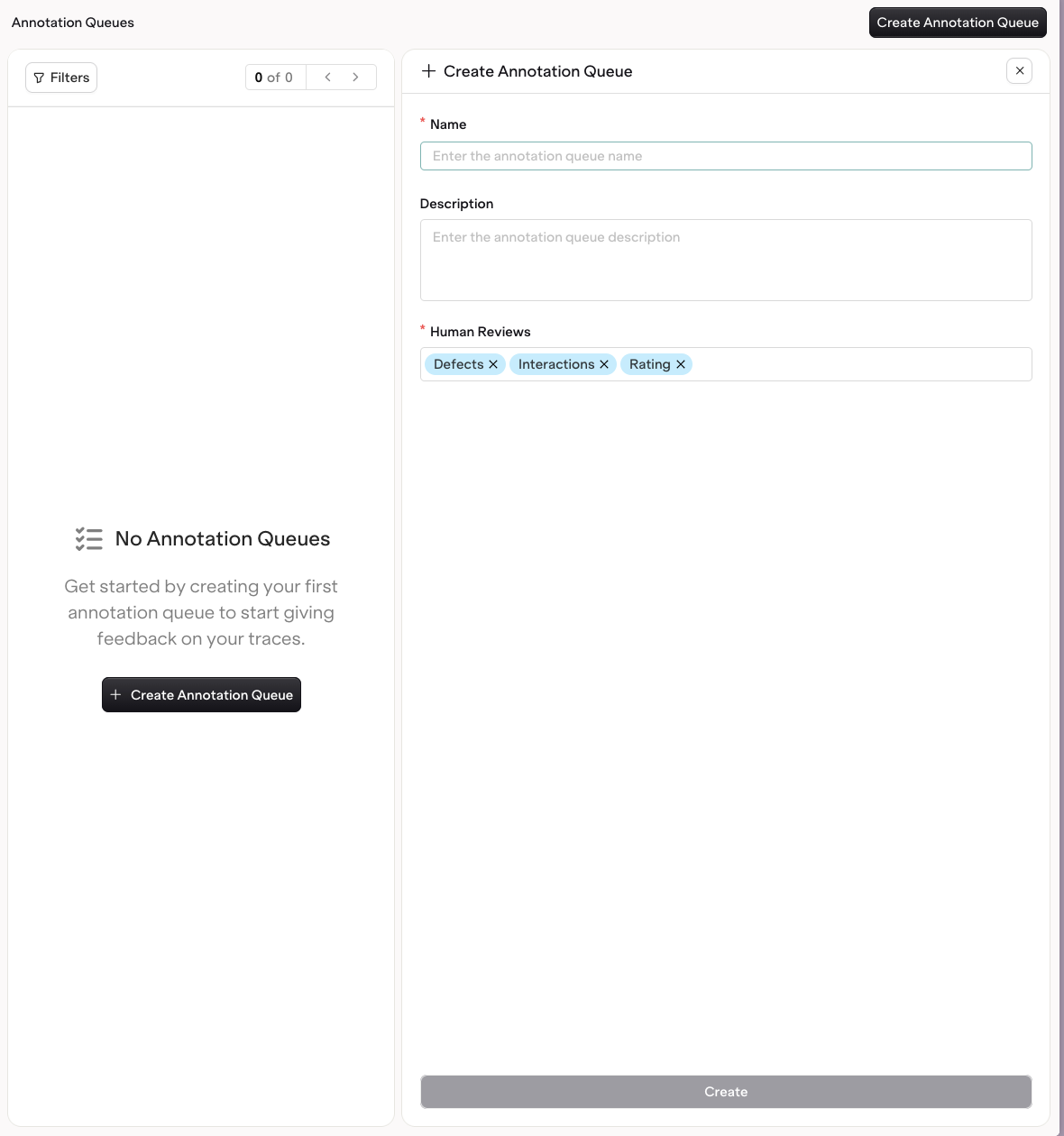
To create an Annotation Queue, head to **AI Studio > Annotation Queue**.
Choose **Create Annotation Queue**.
The following fields are configurable:
* The **Name** of the queue
* The **Description** of the Annotation Queue
* The [**Human Reviews**](/docs/ai-studio/observability/annotation-queues#create-human-review) that Traces will be reviewed by
Corrections are valuable for building curated datasets. Learn more in [Creating a Curated Dataset](/docs/datasets/creating).
Here are examples on how to use the API to annotate LLM responses.
```bash cURL theme={"theme":{"light":"github-light","dark":"github-dark"}}
curl -X POST "https://api.orq.ai/v2/traces/{trace_id}/spans/{span_id}/annotation" \
-H "Authorization: Bearer $ORQ_API_KEY" \
-H "Content-Type: application/json" \
-d '{
"annotations": [
{
"key": "rating",
"value": "good"
}
]
}'
```
```python Python theme={"theme":{"light":"github-light","dark":"github-dark"}}
from orq_ai_sdk import Orq
import os
orq = Orq(api_key=os.getenv("ORQ_API_KEY"))
result = orq.annotations.create(
trace_id="",
span_id="",
annotations=[
{
"key": "rating",
"value": "good"
}
]
)
print(result)
```
```typescript TypeScript theme={"theme":{"light":"github-light","dark":"github-dark"}}
import { Orq } from "@orq-ai/node";
const orq = new Orq({
apiKey: process.env.ORQ_API_KEY,
});
const result = await orq.annotations.create({
traceId: "",
spanId: "",
annotations: [
{
key: "rating",
value: "good"
}
]
});
console.log(result);
```
```bash cURL theme={"theme":{"light":"github-light","dark":"github-dark"}}
curl -X POST "https://api.orq.ai/v2/traces/{trace_id}/spans/{span_id}/annotation" \
-H "Authorization: Bearer $ORQ_API_KEY" \
-H "Content-Type: application/json" \
-d '{
"annotations": [
{
"key": "defects",
"value": ["grammatical", "spelling", "ambiguity"]
}
]
}'
```
```python Python theme={"theme":{"light":"github-light","dark":"github-dark"}}
from orq_ai_sdk import Orq
import os
orq = Orq(api_key=os.getenv("ORQ_API_KEY"))
result = orq.annotations.create(
trace_id="",
span_id="",
annotations=[
{
"key": "defects",
"value": ["grammatical", "spelling", "ambiguity"]
}
]
)
print(result)
```
```typescript TypeScript theme={"theme":{"light":"github-light","dark":"github-dark"}}
import { Orq } from "@orq-ai/node";
const orq = new Orq({
apiKey: process.env.ORQ_API_KEY,
});
const result = await orq.annotations.create({
traceId: "",
spanId: "",
annotations: [
{
key: "defects",
value: ["grammatical", "spelling", "ambiguity"]
}
]
});
console.log(result);
```
```bash cURL theme={"theme":{"light":"github-light","dark":"github-dark"}}
curl -X POST "https://api.orq.ai/v2/traces/{trace_id}/spans/{span_id}/annotation" \
-H "Authorization: Bearer $ORQ_API_KEY" \
-H "Content-Type: application/json" \
-d '{
"annotations": [
{
"key": "confidence_score",
"value": 0.95
}
],
"metadata": {
"identityId": "user-123"
}
}'
```
```python Python theme={"theme":{"light":"github-light","dark":"github-dark"}}
from orq_ai_sdk import Orq
import os
orq = Orq(api_key=os.getenv("ORQ_API_KEY"))
result = orq.annotations.create(
trace_id="",
span_id="",
annotations=[
{
"key": "confidence_score",
"value": 0.95
}
],
metadata={
"identityId": "user-123"
}
)
print(result)
```
```typescript TypeScript theme={"theme":{"light":"github-light","dark":"github-dark"}}
import { Orq } from "@orq-ai/node";
const orq = new Orq({
apiKey: process.env.ORQ_API_KEY,
});
const result = await orq.annotations.create({
traceId: "",
spanId: "",
annotations: [
{
key: "confidence_score",
value: 0.95
}
],
metadata: {
identityId: "user-123"
}
});
console.log(result);
```
```bash cURL theme={"theme":{"light":"github-light","dark":"github-dark"}}
curl -X POST "https://api.orq.ai/v2/traces/{trace_id}/spans/{span_id}/annotation" \
-H "Authorization: Bearer $ORQ_API_KEY" \
-H "Content-Type: application/json" \
-d '{
"annotations": [
{
"key": "correction",
"value": "The correct answer should emphasize scalability and fault tolerance."
}
]
}'
```
```python Python theme={"theme":{"light":"github-light","dark":"github-dark"}}
from orq_ai_sdk import Orq
import os
orq = Orq(api_key=os.getenv("ORQ_API_KEY"))
result = orq.annotations.create(
trace_id="",
span_id="",
annotations=[
{
"key": "correction",
"value": "The correct answer should emphasize scalability and fault tolerance."
}
]
)
print(result)
```
```typescript TypeScript theme={"theme":{"light":"github-light","dark":"github-dark"}}
import { Orq } from "@orq-ai/node";
const orq = new Orq({
apiKey: process.env.ORQ_API_KEY,
});
const result = await orq.annotations.create({
traceId: "",
spanId: "",
annotations: [
{
key: "correction",
value: "The correct answer should emphasize scalability and fault tolerance."
}
]
});
console.log(result);
```
```bash cURL theme={"theme":{"light":"github-light","dark":"github-dark"}}
curl -X POST "https://api.orq.ai/v2/traces/{trace_id}/spans/{span_id}/annotation" \
-H "Authorization: Bearer $ORQ_API_KEY" \
-H "Content-Type: application/json" \
-d '{
"annotations": [
{
"key": "rating",
"value": "good"
},
{
"key": "confidence_score",
"value": 0.92
},
{
"key": "categories",
"value": ["helpful", "accurate", "concise"]
}
]
}'
```
```python Python theme={"theme":{"light":"github-light","dark":"github-dark"}}
from orq_ai_sdk import Orq
import os
orq = Orq(api_key=os.getenv("ORQ_API_KEY"))
result = orq.annotations.create(
trace_id="",
span_id="",
annotations=[
{"key": "rating", "value": "good"},
{"key": "confidence_score", "value": 0.92},
{"key": "categories", "value": ["helpful", "accurate", "concise"]}
]
)
print(result)
```
```typescript TypeScript theme={"theme":{"light":"github-light","dark":"github-dark"}}
import { Orq } from "@orq-ai/node";
const orq = new Orq({
apiKey: process.env.ORQ_API_KEY,
});
const result = await orq.annotations.create({
traceId: "",
spanId: "",
annotations: [
{ key: "rating", value: "good" },
{ key: "confidence_score", value: 0.92 },
{ key: "categories", value: ["helpful", "accurate", "concise"] }
]
});
console.log(result);
```
```bash cURL theme={"theme":{"light":"github-light","dark":"github-dark"}}
curl -X DELETE "https://api.orq.ai/v2/traces/{trace_id}/spans/{span_id}/annotation" \
-H "Authorization: Bearer $ORQ_API_KEY" \
-H "Content-Type: application/json" \
-d '{
"keys": ["rating", "defects"]
}'
```
```python Python theme={"theme":{"light":"github-light","dark":"github-dark"}}
from orq_ai_sdk import Orq
import os
orq = Orq(api_key=os.getenv("ORQ_API_KEY"))
result = orq.annotations.delete(
trace_id="",
span_id="",
keys=["rating", "defects"]
)
print(result)
```
```typescript TypeScript theme={"theme":{"light":"github-light","dark":"github-dark"}}
import { Orq } from "@orq-ai/node";
const orq = new Orq({
apiKey: process.env.ORQ_API_KEY,
});
const result = await orq.annotations.delete({
traceId: "",
spanId: "",
keys: ["rating", "defects"]
});
console.log(result);
```
**API Error Handling**
| Status Code | Error | Example Message | Solution |
| ----------- | ---------------------- | ------------------------------------------------------------------------ | ---------------------------------------------------------------------------- |
| **404** | Human Review Not Found | `The human review with key "rating" for workspace abc123 was not found.` | Create a Human Review with the specified key before annotating. |
| **404** | Span Not Found | `Span with id xyz789 for workspace abc123 was not found.` | Verify the `trace_id` and `span_id` are correct and belong to the workspace. |
| **400** | Invalid Value | `Invalid value: poor. Valid options are: good, bad.` | Ensure the value matches the options defined in the Human Review. |
| **400** | Value Out of Range | `Value 15 is out of range [0, 10].` | Provide a number within the defined min/max range for the Human Review. |
| **400** | String Too Long | `String value exceeds maximum length of 200 characters.` | Shorten the string annotation to 200 characters or less. |
See a complete feedback loop implemented from scratch. Read our cookbook [Capturing User Feedback](/docs/tutorials/capturing-feedback-with-orq).
**Constraints**
* **Batch Limits**: up to 10 annotations per create request, up to 10 keys per delete request
* **String Length**: string values are limited to 200 characters maximum
* **Deployment Span Propagation**: when annotating a deployment span, the associated log is automatically annotated with the same values
* **Metadata Fields**: optional `metadata` object supports `identityId`, `source`, and `reviewerId` for tracking and attribution
## Create Annotation Queues
Annotation Queues help you organize and apply Human Reviews effectively to relevant incoming Traces.
To create an Annotation Queue, head to **AI Studio > Annotation Queue**.
Choose **Create Annotation Queue**.
The following fields are configurable:
* The **Name** of the queue
* The **Description** of the Annotation Queue
* The [**Human Reviews**](/docs/ai-studio/observability/annotation-queues#create-human-review) that Traces will be reviewed by
 ## Fill Annotation Queues
Once a queue exists, fill it with the Traces to review. Traces can be added automatically or manually.
Use [Trace Automations](/docs/ai-studio/observability/automations) to route Traces into a queue based on configured rules. Add an **Add to Annotation Queue** action to an automation and select the target queue. As matching Traces arrive, they are added to the queue without manual effort, which keeps a steady stream of relevant Traces ready for review.
## Fill Annotation Queues
Once a queue exists, fill it with the Traces to review. Traces can be added automatically or manually.
Use [Trace Automations](/docs/ai-studio/observability/automations) to route Traces into a queue based on configured rules. Add an **Add to Annotation Queue** action to an automation and select the target queue. As matching Traces arrive, they are added to the queue without manual effort, which keeps a steady stream of relevant Traces ready for review.
 Open a Trace, select a span, and choose **Add to annotation queue** to send it to a queue one at a time. This is useful for ad hoc review of specific Traces that are worth a closer look.
 ## Use Annotation Queues
Open an Annotation Queue to step through its Traces one at a time in the review screen.
## Use Annotation Queues
Open an Annotation Queue to step through its Traces one at a time in the review screen.
 The screen is divided into three panels:
* **Left**: details for the selected Trace.
* **Inputs**: the variables mapped to inputs, when configured.
* **Metrics**: latency, cost, and token usage.
* **Task**: the model, provider, and other configuration parameters.
The header shows the current position, the total number of items in the queue, and how many have already been reviewed.
* **Center**: the full interaction for the selected Trace.
* **Right**: the **Annotations** panel with the [**Human Reviews**](/docs/ai-studio/observability/annotation-queues#create-human-review) configured for the queue, such as a rating with categorical buttons or an open comment field. Selecting a value saves immediately and marks the Trace as reviewed.
Navigate between items with **`K`** (previous) and **`J`** (next), or use the up and down buttons at the top left.
When a data point is worth reusing, select **Add to dataset** to send the Trace to a [Dataset](/docs/ai-studio/optimize/datasets) for use in a future [Experiment](/docs/ai-studio/optimize/experiments).
Adding a Trace to a Dataset does not copy its annotations for now. As noted above, the annotation values stay on the originating Trace, where they remain queryable via the **Orq MCP**.
## Annotations in Experiments
Human Reviews can also be applied outside of Annotation Queues, while reviewing the outputs of an [Experiment](/docs/ai-studio/optimize/experiments). In the experiment review screen, the Human Reviews defined for the project appear alongside Evaluator scores, so outputs can be annotated manually as part of an evaluation run.
The screen is divided into three panels:
* **Left**: details for the selected Trace.
* **Inputs**: the variables mapped to inputs, when configured.
* **Metrics**: latency, cost, and token usage.
* **Task**: the model, provider, and other configuration parameters.
The header shows the current position, the total number of items in the queue, and how many have already been reviewed.
* **Center**: the full interaction for the selected Trace.
* **Right**: the **Annotations** panel with the [**Human Reviews**](/docs/ai-studio/observability/annotation-queues#create-human-review) configured for the queue, such as a rating with categorical buttons or an open comment field. Selecting a value saves immediately and marks the Trace as reviewed.
Navigate between items with **`K`** (previous) and **`J`** (next), or use the up and down buttons at the top left.
When a data point is worth reusing, select **Add to dataset** to send the Trace to a [Dataset](/docs/ai-studio/optimize/datasets) for use in a future [Experiment](/docs/ai-studio/optimize/experiments).
Adding a Trace to a Dataset does not copy its annotations for now. As noted above, the annotation values stay on the originating Trace, where they remain queryable via the **Orq MCP**.
## Annotations in Experiments
Human Reviews can also be applied outside of Annotation Queues, while reviewing the outputs of an [Experiment](/docs/ai-studio/optimize/experiments). In the experiment review screen, the Human Reviews defined for the project appear alongside Evaluator scores, so outputs can be annotated manually as part of an evaluation run.
