Prompts store all configuration for interacting with a model: system instructions, messages, model selection, and parameters. A Prompt can be reused across Playgrounds, Experiments, Deployments, and Agents.

Use Cases

Use prompts as shared instructions so every team and application produces consistent, aligned outputs.
Package prompts as configurable building blocks that can be reused across products, workflows, and experiments.
Adjust behavior, tone, and structure by editing prompts instead of modifying application logic.
Roll out improvements, A/B test variations, and manage risk through prompt versioning and controlled updates.
Embed domain rules, policies, and structured outputs directly into prompts to align AI with business needs.

Create a Prompt

1

Navigate to a Project

Open a Project and click the + button at the top.
2

Select Prompt

Choose Prompt from the menu. The Prompt editor opens in AI Studio.
Standalone prompts are stored in the Project and can be reused across Playgrounds, Experiments, Agents, and Deployments.

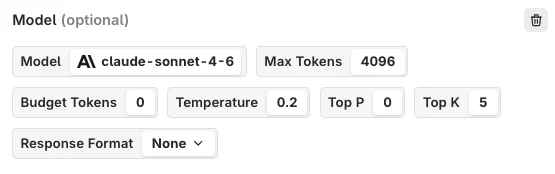
Choose a Model

Select a model from the model picker at the top of the Prompt editor.
A model must be available through the AI Gateway to appear in the picker.
Choose a Model

Model Parameters

Controls creativity and predictability. Higher values produce more diverse, surprising responses. Lower values produce more predictable output that sticks closely to learned patterns.
Sets the upper limit on tokens the model can produce in a single output. Prevents excessively long responses while ensuring enough room for a complete answer.
Narrows the model’s choices to the k most likely tokens at each generation step. Helps refine output to follow particular patterns or meet specific criteria.
Nucleus sampling. Selects a pool of likely words based on a probability threshold, balancing creativity with coherence.
Discourages the model from reusing the same words or phrases, encouraging richer and more varied language.
Discourages repeated topics or ideas rather than specific words. Higher values lead to more creative and diverse responses.

Messages

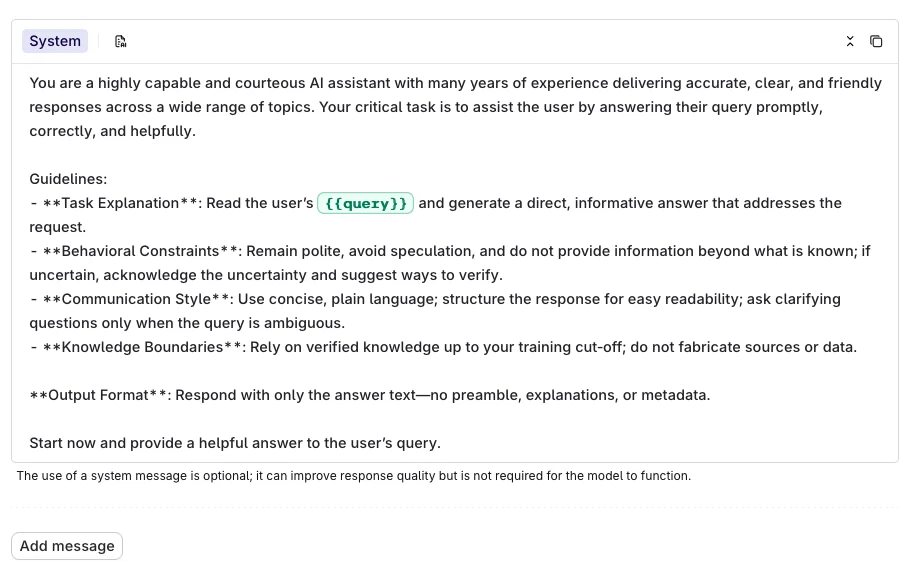
Select Add Message in the Prompt Template panel to add a message. Messages define the context the model receives before generating a response.
The prompt template used as context for the language model.

Roles

When adding a message, choose a role to define how the model interprets it:
RoleDescriptionExample
SystemA guideline or context for the language model, directing how it should interpret and respond to requests.”You are an expert botanist. Respond briefly to questions with one-line answers.”
UserAn actual query posed by the user.”Which plants thrive in shady environments?”
AssistantResponses to user queries by the language model.”Ferns, Hostas, and Hydrangeas are some plants that thrive in shady environments.”

Variables

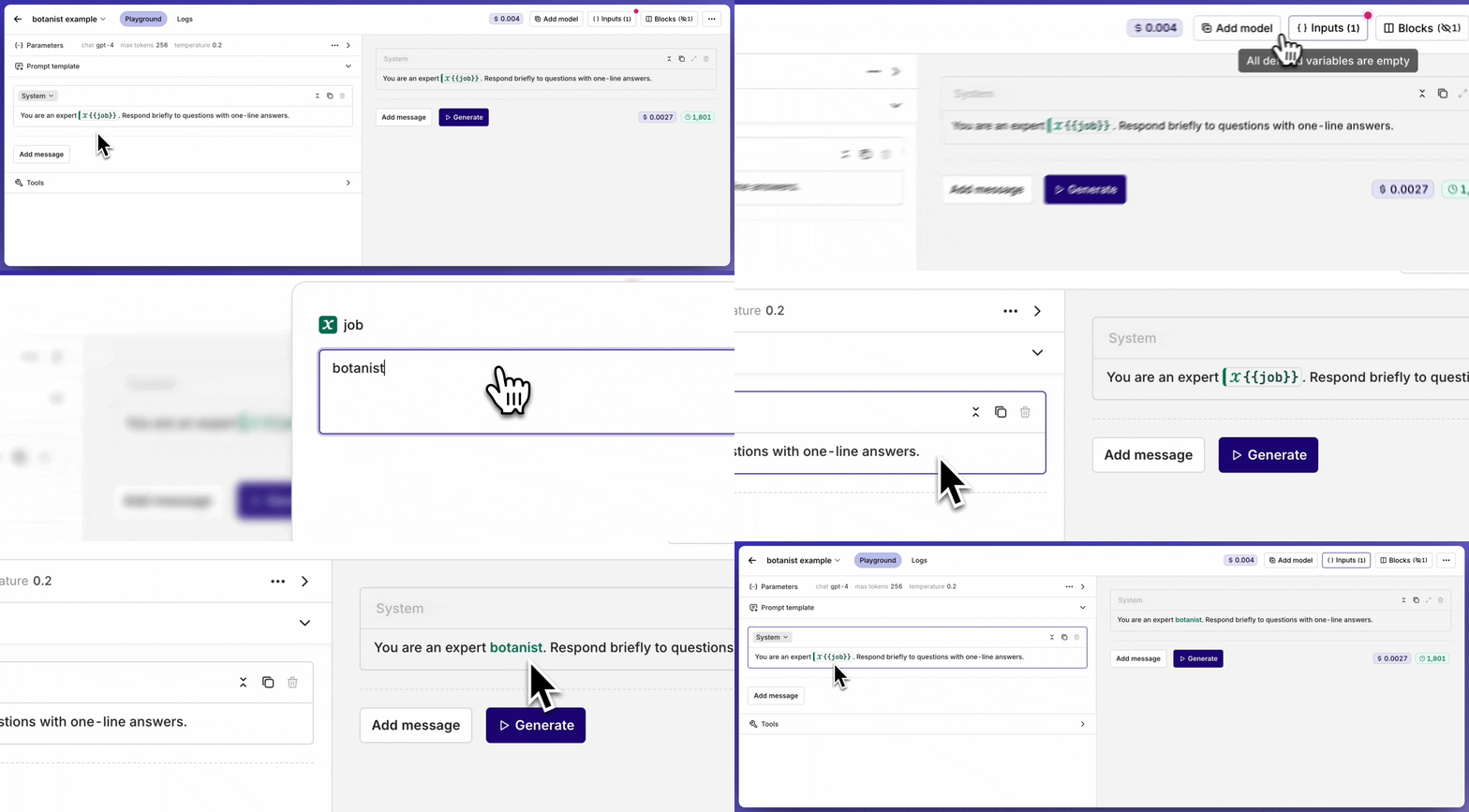
Use {{variable_name}} syntax inside a message to declare a dynamic input. All declared inputs appear in the Inputs block at the top-right of the page, where default values can be set for testing.The example below shows the inputs being set while running the prompt in the Playground.
Inputs block in the Playground with a variable value being overridden while running a prompt.
To pass values at runtime in a Deployment, see Variables and Prompt Templating.

Prompt Generator

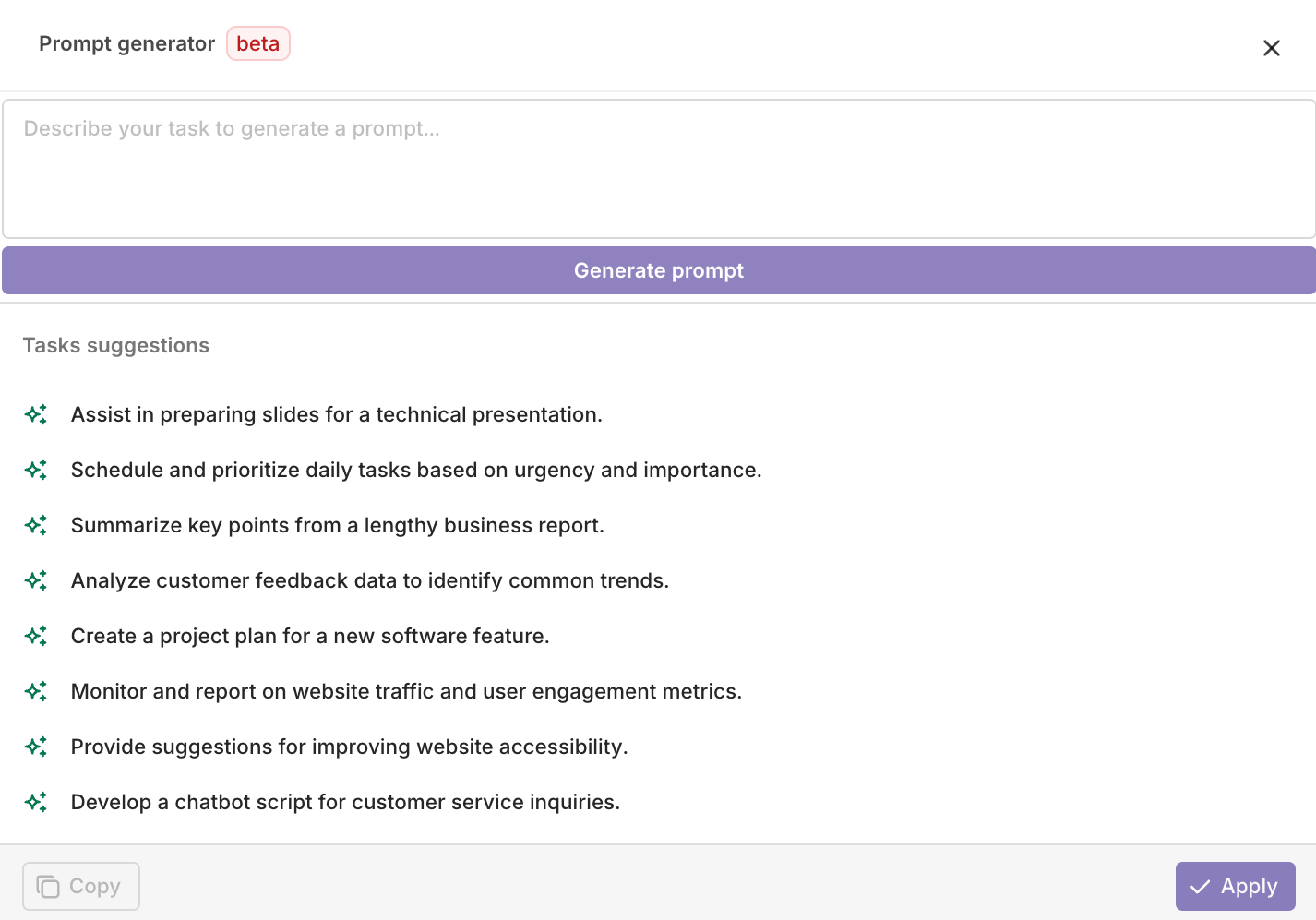
Select the Generate Prompt button next to the Role Selector to open the prompt generation assistant.The Generate Prompt button located next to the Role Selector in the prompt editor.
  • Select Copy to copy the generated prompt to the clipboard.
  • Select Apply to overwrite the current prompt with the generated one. The prompt generation assistant showing a generated prompt with Copy and Apply buttons.

Fetch a Prompt

Retrieve a Prompt by its ID using the Retrieve a Prompt API.
curl --request GET \
     --url https://api.orq.ai/v2/prompts/PROMPT_ID \
     --header 'accept: application/json' \
     --header 'authorization: Bearer ORQ_API_KEY'