

v4.13.0 Beta
Find out that production drifted from a notification, not from a customer. Alerts watch a metric over a rolling window and notify a destination the moment a threshold is crossed, so a cost spike, a latency regression, or a burst of errors surfaces on its own.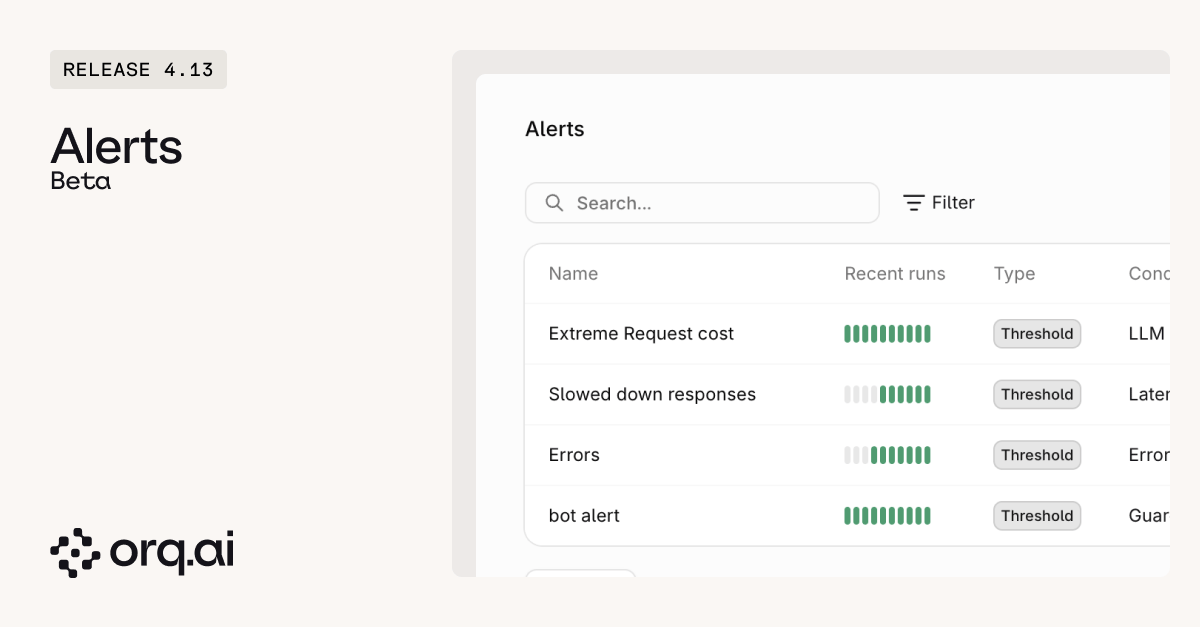
- Five signals: Start from Cost, Latency, Errors, or Guardrails, or pick Custom to alert on any metric in the catalogue.
- Rolling windows and check intervals: Evaluate over 5 minutes to 1 day, and check as often as every 5 minutes.
- Notifiers: Route to the same email, Slack, and webhook destinations already used by Budgets, so a destination is configured once and reused.
- Trigger view with drill-down: See every firing on the alert detail page and open the event that caused it.
v4.13.0
The Smart Router has its own page in the AI Gateway that shows every configured router, which band each model lands in, and how to call the router from an application.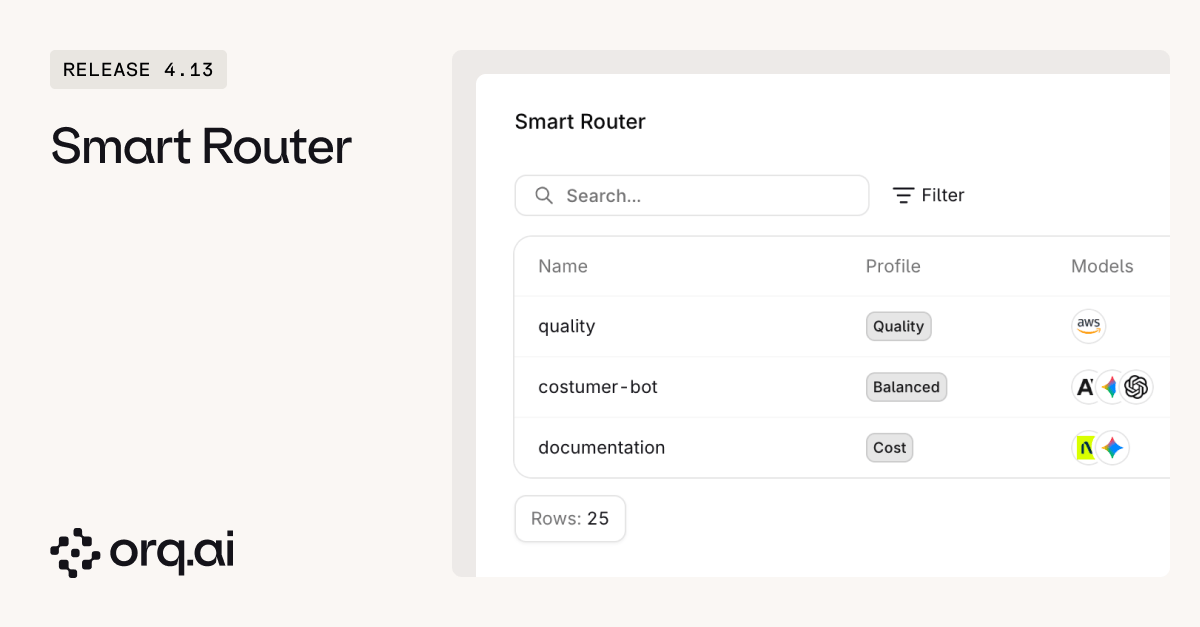
- Preview bands: See which models sit in each band before traffic is sent, including Opus 4.8 and Fable 5 in the hard band.
- Invocation snippet: Copy a working call straight from the router page, with tooltips explaining every column.
- Model pool routing: The
route_pooloperation picks from N candidate models rather than only a strong and an economical pair.
Set up intelligent routing from the Smart Router guide.
v4.13.0 Beta
Structured output that comes back wrapped in a markdown fence or carrying a trailing comma now parses instead of throwing. The 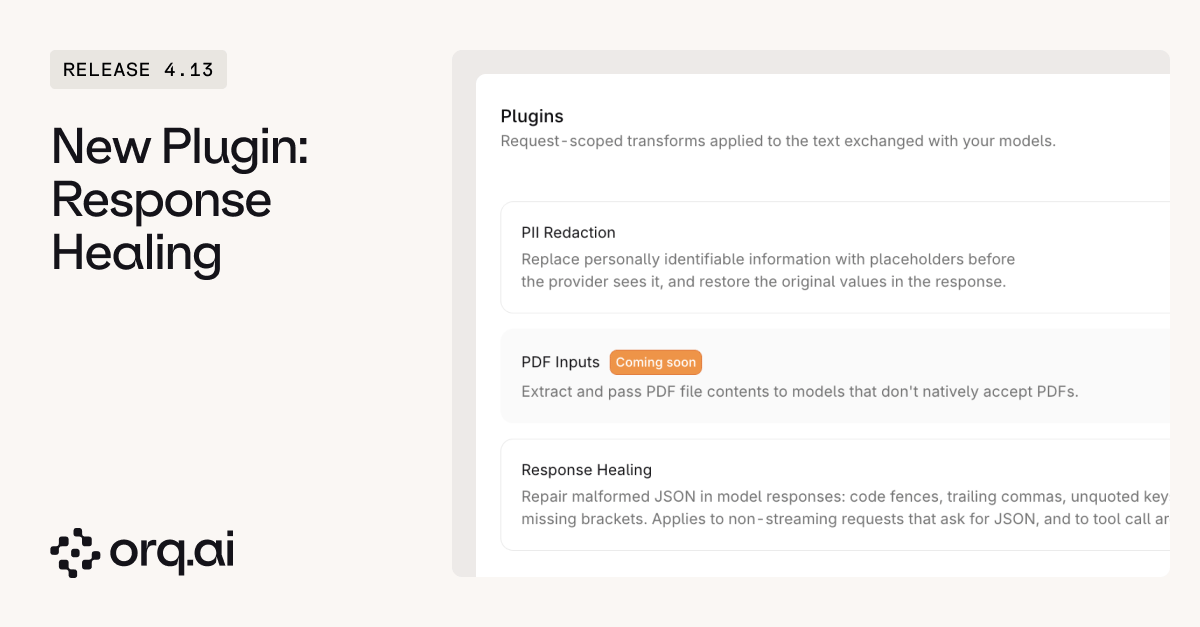
response_healing plugin repairs malformed JSON before the response reaches the caller, so per-service JSON cleanup code can come out of the client.- Six repair classes: Markdown code fences, JSON embedded in prose, missing closing brackets, trailing commas, unquoted keys, and single-quoted strings.
- Tool call arguments too: Arguments are repaired whenever the plugin is enabled, with no
response_formatrequired. - Workspace-wide switch: Enable it for every request from Settings > Plugins instead of passing a
pluginsarray on each call.
Repairs apply to non-streaming requests only. See the Response Healing plugin page.
v4.13.0
- Advisor and Sidekick tools: An Agent can consult a second model mid-turn. Advisor returns short guidance on the conversation so far, capped by
max_usesand a transcript budget. Sidekick takes a discrete task and returns only the finished result, with its own instructions and output format. Both meter separately and nest their own spans, and a failed secondary call degrades to a message instead of failing the turn. - Redesigned Thread view: The conversation view in Traces is rebuilt around message blocks, with header stats, per-message avatars, granular navigation anchors, and a tool badge in the thread navigation so tool steps are easy to jump between.
- Favourites in the sidebar: Star any entity to pin it to a Favourites section in the sidebar and a dedicated Favourites page. Stars are available on Agents, Prompts, Datasets, Evaluators, Knowledge Bases, Memory Stores, and MCPs.
v4.13.0
- Renaming: Chat is now Playground in the platform toggle.
- Higher token ceilings: OpenAI-compatible providers accept a max tokens value above 128k, up to 10M.
- Cleaner Router errors: Error envelopes are consistent across providers so OpenAI and Vercel AI SDK error parsing works, and rate-limited requests return
Retry-After. - Guardrail sampling: System guardrails support non-blocking mode and sampling, matching what user guardrails already allowed.
- Reset a conversation in the Agent Playground: Clear conversation history without leaving the playground.
- API key expiry at a glance: The API Keys table gains an expiration date column.
- Annotation queues API: The Annotation Queues API is public and documented in the OpenAPI spec.
store: falseon Responses: Callers can opt out of persistence on/v1/responses.- Entity context in search: Search results show which project an entity belongs to.
- Jump from a span to its source: Trace spans link straight to the Agent or Prompt that produced them.
v4.13.0
New additions to the Model Garden, plus two new providers: Fireworks and Baseten. Browse details on the Supported Models page.
Model metadata also gained an intelligence index, which is what the Smart Router bands read from.
v4.13.0
- Tool schemas reach the model intact:
$defsand$refare no longer stripped fromtools[].function.parameterson the Anthropic and Google paths, and therequiredarray survives on Anthropic chat completions. - Tool choice is honored: Anthropic-native
tool_choicerespectsrequiredinstead of downgrading toauto, anddisable_parallel_tool_useis no longer dropped. - Provider errors stay truthful: Upstream 4xx and 404 responses pass through instead of being remapped to 500, including the Google and Vertex paths, and a thinking model that spends its whole budget on reasoning no longer returns an empty 500.
- Streaming completes on tool calls: A Router
/responsesstream that carries a tool call now ends withresponse.completed, so OpenAI-compatible clients no longer hang waiting for the terminal event. - Pre-flight validation: Unsupported
response_formatandservice_tiervalues are rejected before the provider call rather than surfacing as a provider 400. - Image endpoints:
gpt-image-1acceptsresponse_format, which unblocks Vercel AI SDK image calls, and non-streaming image responses report standard usage includingtotal_tokens. - Reasoning token billing:
gemini-2.5-proreasoning tokens are metered separately instead of being counted inside output tokens, which had overstated cost significantly. - Embedding spend is attributed: Embedding calls from Knowledge Bases and Memory Stores record spend and reach Budgets.
- Traces accuracy: The name filter is project scoped, spans show display names for private models instead of raw provider ids, Azure AI Inference tool-call output is stored rather than dropped, and span and agent-run counts match what Traces shows.
- Knowledge reliability: Chunk metadata updates persist to the search index,
rerank_configon the search API is applied instead of being accepted and ignored, Jina reranking succeeds, and multi-chunk ingestion withgoogle/gemini-embedding-2completes. - Evaluators: A PATCH no longer discards
modeland other arm fields whenmodeis omitted,dataset_idround-trips onllm_eval, and output evaluators read the correct turn when an Agent ends on a tool call. - SDKs:
/v2/deployments/streamreturnstext/event-stream,agents.list()accepts a null model parameters object,refreshKeyCard()works without a request body, andPOST /v2/fileskeeps the filename and returnsobject_name. - Sign-in: OIDC sign-in lands on the workspace instead of onboarding or a missing page.