Enabling new Models in your Workspace

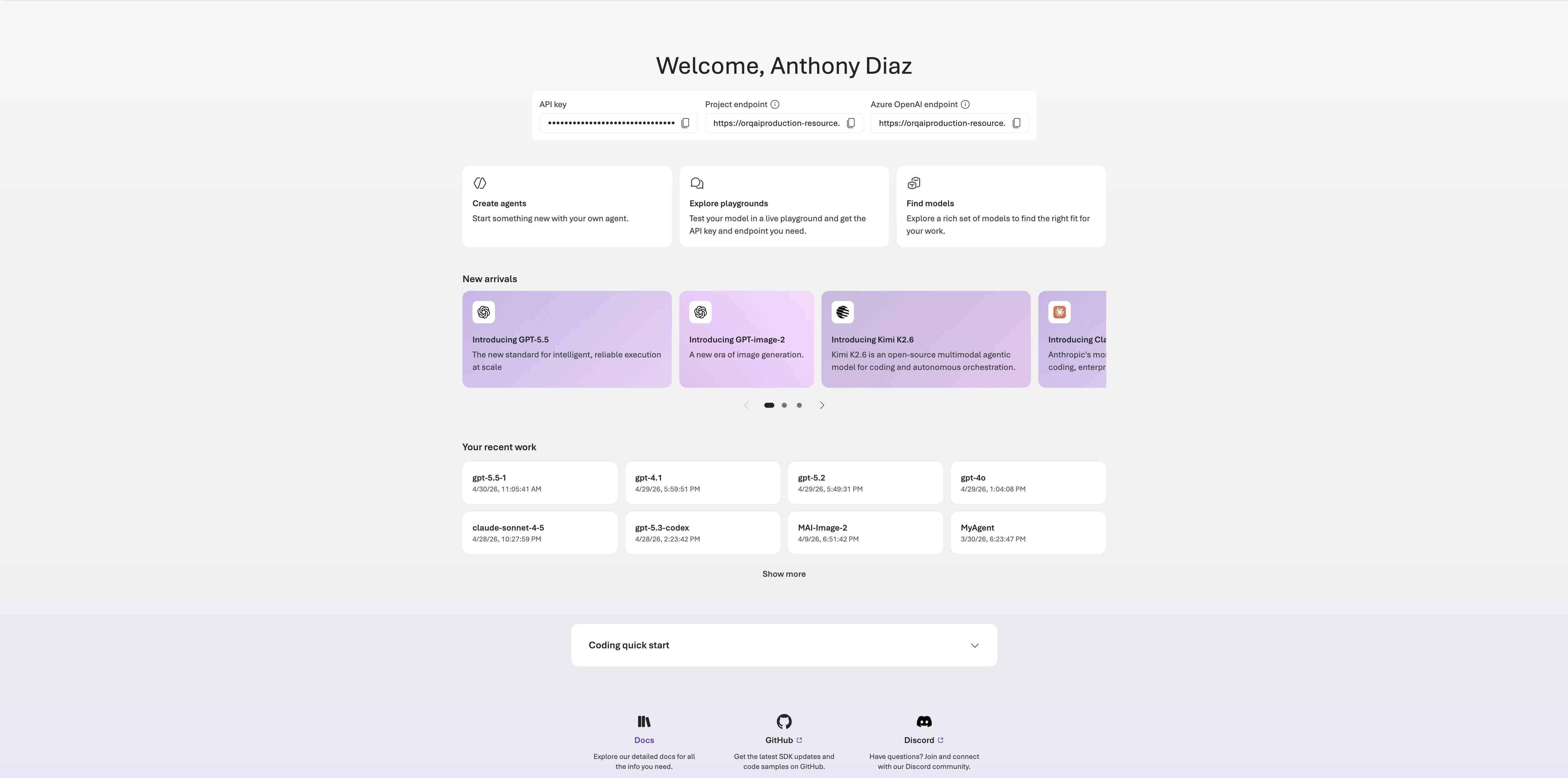
To get started with enabling models in your Workspace, ensure you connected your API keys to the desired Providers, to learn more see Connecting Providers.
To see your AI Router head to the AI Router section in your orq.ai Studio.
AI Router Models
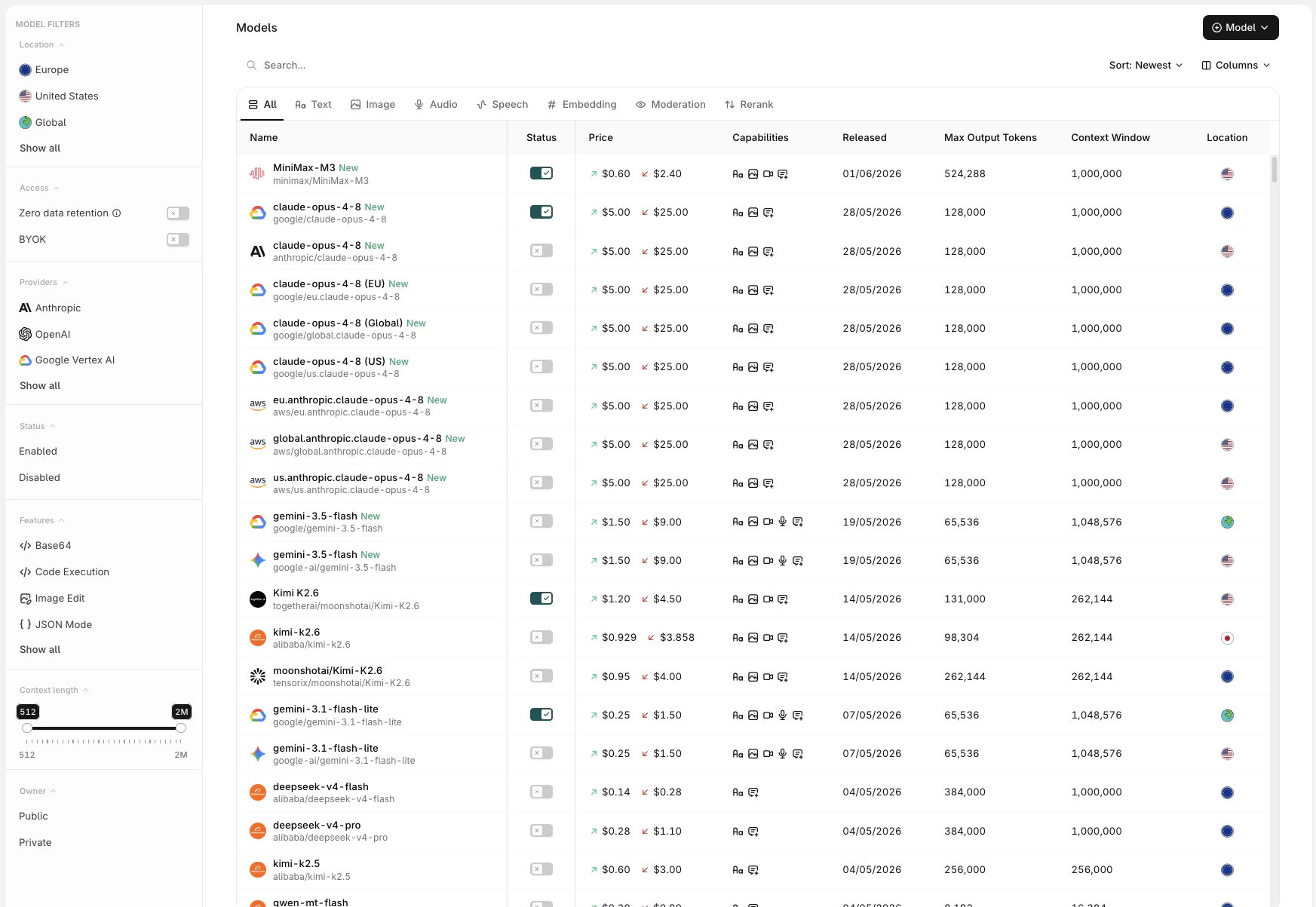
You have access to multiple filters to search models:
  • Providers let you filter which LLM provider you want to see.
  • Model Type lets you decide on which type of model you intend to see (Chat, Completion, Embedding, Rerank, Vision).
  • Active lets you filter on enabled or disabled models in your workspace.
  • Owner lets you filter between Orq.ai provided models and private models.
  • API Key Status lets you filter models for which you have added an API key.
You can now filter by Location to display models available in Europe, US, or globally only.AI Router Filter Location
You can preview the pricing of each model within the Pricing column. To enable a model, toggle it on. It will immediately be available in any Prompt.

Connecting Providers

For production workloads, use your API keys with the supported Providers. To set up your own API Key, head to the AI Studio and to the AI Router > Providers section. Choose the provider you wish to set an API key for and press Connect, then select Setup your own API Key
AI Router Providers

Deeper Provider Integrations

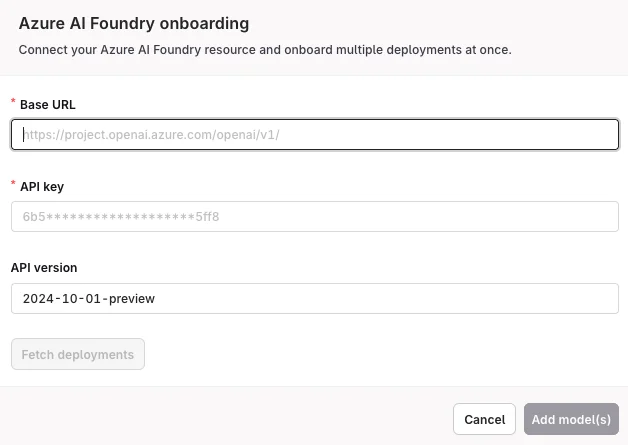
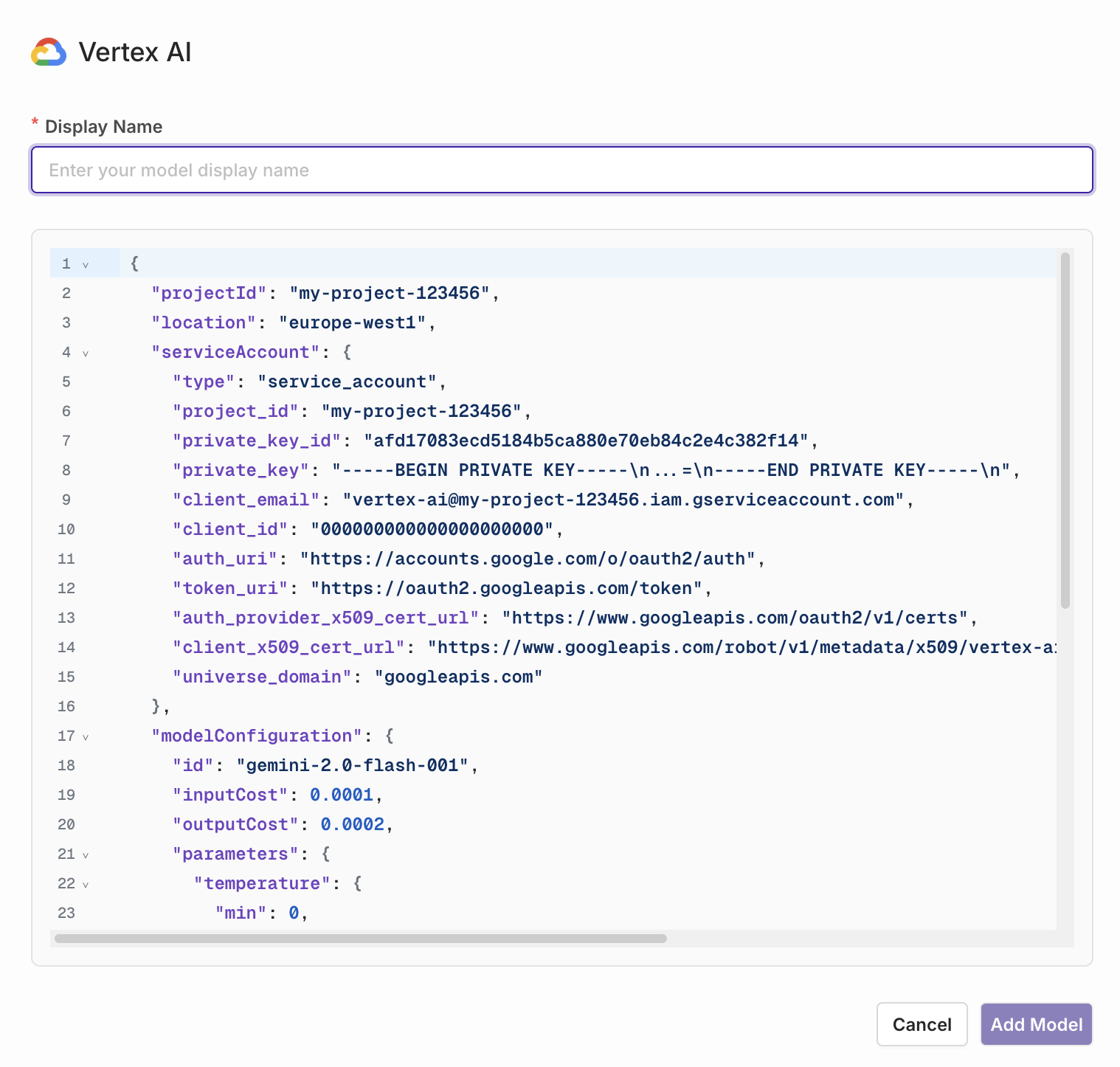
Some providers require specific configurations, see the related documentation:

Having Multiple API Keys

You can decide to configure multiple API for a single provider, to do so, select Add a new API key.

Benefits of using multiple API Keys

Credential Failure
Having a different API key available to use models can be useful in case one becomes invalid or for instance runs out of credit. Having an extra key configured on a fallback model can make sure you respond in all cases.
Multiple Environments
In case you have multiple API keys used for different purposes, this lets you organize your models to use the credentials dedicated to the correct environment.

Using a specific API keys in model configuration

Once your API keys are configured within the Providers panel, you can use them within Playground, Experiment, Deployment, and Agent. This feature is accessible to any model, including Fallback models.
Multi Api Key Provider

Onboarding Private Models

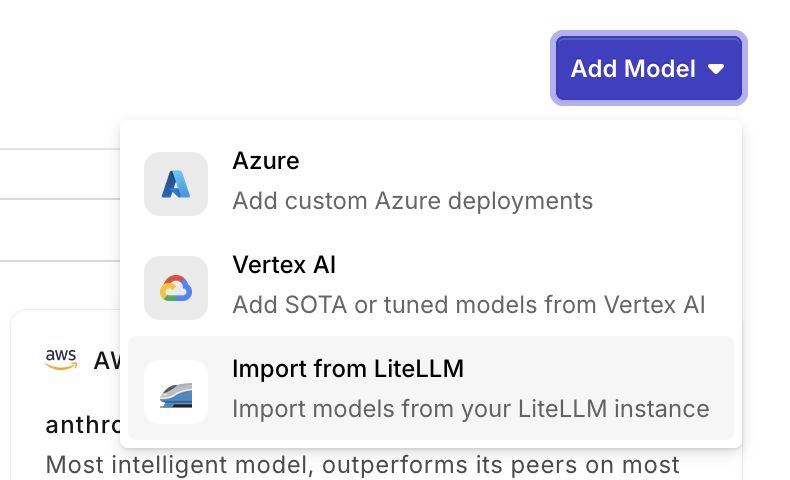
You can onboard private models by choosing Add Model at the top-right of the screen. This can be useful when you have a model fine-tuned outside of orq.ai that you want to use within a Deployment.

Private Models Providers

Referencing Private Models in Code

When referencing private models through our SDKs, API or Supported Libraries, the model is referenced by the following string: <workspacename>@<provider>/<modelname>.
Example: corp@azure/gpt-4o-2024-05-13

Auto Router

The Auto Router is a virtual model that automatically routes each request to the most appropriate model for it. Simple requests go to a cheaper model; requests that benefit from higher quality go to a stronger one. The routing decision is based on predicted human preference, computed in real time from the content of the prompt. To create an Auto Router, click Add Model at the top-right of the AI Router and select Auto Router from the dropdown.
Auto Router configuration
Configure the following fields:
  • Model ID: a unique identifier for this router. Lowercase letters, numbers, and hyphens only (e.g. my-auto-router). This is how you reference the router in your deployments.
  • Strong Model: the higher-quality model to route to when the prompt warrants it.
  • Economical Model: the cheaper model to use for simpler requests.
  • Profile: controls how aggressively the router favours the strong model:
ProfileBehaviour
QualityRoutes more requests to the strong model. Prioritises quality over cost.
BalancedDistributes requests between both models based on prompt complexity.
CostFavours the economical model more aggressively to reduce spend.
Once created, the Auto Router appears in your AI Router and can be selected anywhere a model is accepted: Deployments, Agents, Playground, and Experiments.
Models from the same family or tier work well together (e.g. Claude Sonnet and Gemini Flash). Very large capability gaps reduce the effectiveness of routing.
These pairs combine high routing accuracy with significant cost ratios (over 10x), making them effective starting points for Auto Router configurations.
Strong ModelBudget Model
Google Gemini 2.5 ProGoogle Gemini 2.5 Flash
OpenAI GPT-5.1OpenAI GPT-4o Mini
Anthropic Claude Opus 4Google Gemini 3 Flash
OpenAI GPT-4oOpenAI GPT-4o Mini

Referencing an Auto Router in Code

When using an Auto Router through the SDKs, API, or Supported Libraries, reference it by the following string: <workspacename>@orq/<model-id>.
Example: acme@orq/my-auto-router

Credits

The Credits tab lets you manage your AI Router balance, add payment methods, configure automatic top-ups, and track all credit transactions.
Using credits, you can access Supported Models without needing a personal API key for each provider.

Available Balance

Your current credit balance is displayed at the top of the Credits tab. Credits are consumed as you make requests through the AI Router. Each model call deducts from your balance based on token usage and model pricing.
When you exceed the traces included in your package, tracing costs are also deducted from your credits. Credit purchases have a minimum amount of $5.
When your balance reaches zero, all AI Router requests are blocked until credits are added.

Add Credits

Click Add Credits to purchase additional credits and top up your balance.
1

Click Add Credits

Click the Add Credits button in the Available Balance panel.
2

Enter an amount

Enter the dollar amount you want to add to your balance.
3

Add a Tax ID (optional)

Expand the Edit Tax ID section to add your tax identifier. Tax IDs are supported globally. Select your country and the applicable tax ID type, then enter your number. This is optional but recommended for businesses that need it reflected on invoices.
4

Select a payment method

Choose an existing payment method or add a new card.
5

Enter your name and billing address

Provide your name and billing address. This is required for payment processing.
6

Confirm purchase

Confirm the transaction. Credits are added to your balance immediately.

Payment Method

Add a credit card to enable credit purchases and auto top-up. Click Add new in the Payment Method panel to register a card.
At least one payment method is required to enable auto top-up.

Auto Top-up

Auto top-up ensures your balance never runs out by automatically purchasing credits when it drops below a threshold. To configure auto top-up:
  1. Enable the Auto Top-up toggle.
  2. Set the If balance drops below threshold (e.g. $50). A top-up is triggered when your balance falls below this amount.
  3. Set the Add credits amount (e.g. $200). This is the amount automatically added each time.
  4. Click Save changes.
Set your threshold high enough to avoid service interruptions during peak usage. A common setup is to trigger at $50 and add $200.

Transaction History

The Transaction History table shows a log of credit purchases only. Usage deductions from individual API calls are not listed here.
ColumnDescription
DateThe date of the transaction
TimeThe time of the transaction
TypeThe transaction type: Purchase (manual top-up) or Auto Top-up (automatic)
AmountThe credit amount added to your balance
Use the Filter button to narrow down by Purchase or Auto Top-up.

Invoices

Each credit purchase generates an invoice. To open an invoice, click the icon on the corresponding row in the Transaction History table and select Download Invoice.

Settings

The Settings tab lets you manage which models are used by default across your organization.
AI Router Settings
Configure a default model for each use case:
  • Chat: the main model for all chat and conversation flows.
  • Tool calling: handles structured outputs and function calls to external tools or APIs.
  • Embedding: generates vector representations for search and recommendations.
  • Insight: analyzes data, summarizes results, and generates insights.
Click Save changes to apply your selections.