

MCP Integration
Access the Orq.ai workspace directly from Codex. Manage experiments, query traces, and configure agents using natural language.
AI Gateway
Route Codex’s model calls through the AI Gateway for unified tracing and cost tracking.
MCP
With the Orq MCP integration, manage AI workflows directly from Codex while writing code.Prerequisites
- Codex installed
- Active Orq.ai account
- Orq.ai API key
Installation
Add MCP Server via Terminal
Set theORQ_API_KEY environment variable and add the Orq MCP server directly from the terminal:
your-api-key-here with your actual API key from Workspace Settings → API Keys.
Add MCP Server via UI
- Open Codex Settings by clicking Codex → Settings in the top-left menu
- Click MCP Servers in the sidebar
- Click Connect to a custom MCP to open the configuration form
- Fill in the MCP server details:
- Name:
Orq.ai - Connection Type: Select Streamable HTTP tab
- URL:
https://my.orq.ai/v2/mcp
- Name:
- Add authentication in the Environment variables section:
- Click + Add environment variable
- Key:
AUTHORIZATION - Value:
Bearer YOUR_ORQ_API_KEY
- Replace
YOUR_ORQ_API_KEYwith your actual API key from Workspace Settings → API Keys - Click Save
Verification
In Codex chat, ask: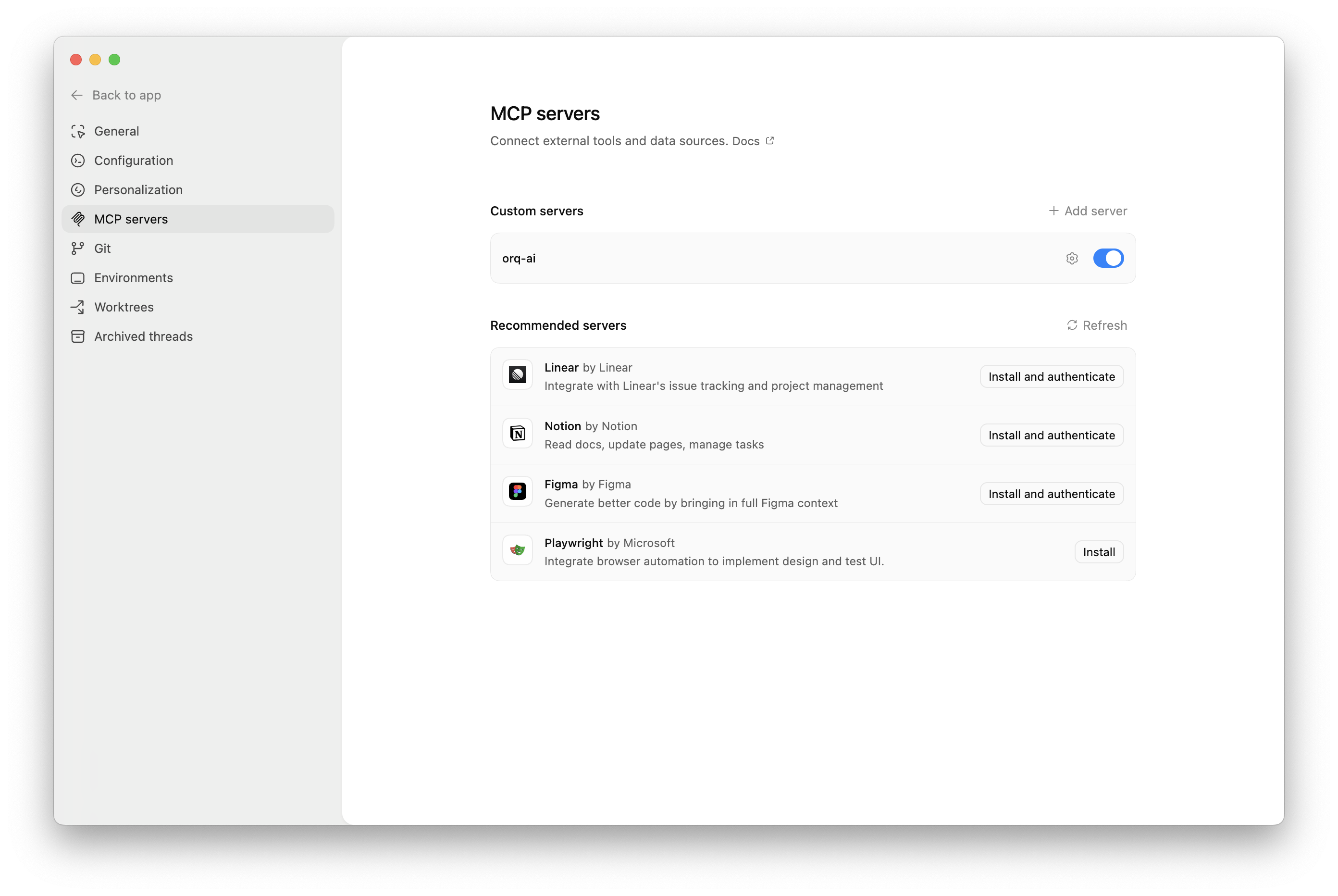
Successfully connected Orq MCP in Codex
Available Commands
Use natural language to ask Codex to perform these operations:Agents
Agents
Create an agent with custom instructions and toolsGet agent configuration for [agent-key]Update agent [agent-key] with new instructions or modelConfigure agent with evaluators and guardrailsInvoke agent [agent-key] with input [message]Retrieve agent response [response-id]
Deployments
Deployments
Create a deployment called [deployment-key]Get deployment configuration for [deployment-key]
Skills
Skills
Create a skill called [skill-key]List all skills in my workspaceGet skill [skill-key]Update skill [skill-key]Delete skill [skill-key]
Analytics
Analytics
Get analytics overview for my workspaceShow me workspace metrics for the last 7 daysQuery analytics filtered by deployment ID
Datasets
Datasets
Create a dataset called "customer-queries"List all datapoints in dataset [dataset-key]Add datapoints to dataset [dataset-key]Update datapoint [datapoint-id]Delete specific datapoints in dataset [dataset-key]Delete dataset [dataset-key]
Experiments
Experiments
Create an experiment from dataset [dataset-key]List all experiment runsExport experiment run [run-id] as CSVRun experiment and auto-evaluate results
Evaluators
Evaluators
Get evaluator configuration for [evaluator-key]Create an LLM-as-a-Judge evaluator for toneCreate a Python evaluator to check response lengthAdd evaluator to experiment [experiment-key]Update evaluator [evaluator-key] with a new promptUpdate Python evaluator [evaluator-key] with revised code
Traces
Traces
List traces from the last 24 hoursShow me traces with errorsGet span details for trace [trace-id]Find the slowest traces from todayShow all traces for thread [thread-id]
Models
Models
List all available chat modelsList all available embedding modelsInvoke model [model-id] with prompt [message]
Search
Search
Search for datasets named "customer"Find experiments in project [project-id]List directories in project [project-id]
Documentation
Documentation
Search the Orq.ai docs for [topic]
Managing Entities
Managing Entities
Delete agent [agent-key]Delete experiment [experiment-key]Delete evaluator [evaluator-key]Delete prompt [prompt-key]Delete knowledge base [knowledge-base-key]
delete_dataset to delete a dataset along with all its datapoints.Troubleshooting
Connection Issues
Connection Issues
- Verify the MCP endpoint URL
- Check the API key is valid
- Ensure network connectivity
- Review Codex logs for errors
Authentication Failures
Authentication Failures
- Confirm API key is valid
- Check API key permissions
- Try regenerating the API key
- Verify the Authorization header format
Tool Execution Errors
Tool Execution Errors
- Check the tool name is correct
- Verify required parameters are provided
- Review error messages in Codex
- Consult MCP tools list
Skills
Orq Skills add pre-built agentic workflows to Codex for the full Build, Evaluate, Optimize lifecycle.Installation
Orq Skills
The full catalogue of skills and slash commands.
Slash commands (
/orq:quickstart, /orq:traces, and others) are only available in Claude Code.AI Gateway
Route every model call Codex CLI makes through the Orq.ai AI Gateway by editing~/.codex/config.toml. Requests appear in Traces automatically.
Prerequisites
- Codex CLI installed
- Active Orq.ai account with AI Gateway access
- Orq.ai API key
- Model enabled in AI Gateway → Supported Models
Setup
1
Export the API key
<your-orq-api-key> with an API key. This sets the variable for the current shell session. To persist it across sessions, add the line to ~/.zshrc or ~/.bashrc.2
Create or edit ~/.codex/config.toml
Create Replace
~/.codex/config.toml if it does not exist. Add or merge the following keys. The top-level model and model_provider lines set the default; the [model_providers.orq] block registers the custom provider:openai/gpt-5.4 with the provider-prefixed model to use by default (e.g. anthropic/claude-sonnet-5). If a model key already exists in the file, replace it.3
Run Codex
codex without flags routes all calls through the AI Gateway using the model configured in ~/.codex/config.toml.Pass --model to override the model for a single invocation:Configuration Reference
Tagging requests
Codex cannot modify the request body, so tag requests by addinghttp_headers to the [model_providers.orq] block:
Trace capture
Codex sends a stable session ID with each Responses request. The AI Gateway uses that ID to group the model round-trips from one Codex run into a session in Traces. Each round-trip remains a Responses trace and includes its model, token usage, cost, and tool calls.Troubleshooting
Authentication error
Authentication error
Confirm
ORQ_API_KEY is exported in the shell running Codex. Run echo $ORQ_API_KEY to verify the value is set.Model not found
Model not found
The model must be enabled in AI Gateway → Supported Models before Codex can route to it. Check that the model ID in
config.toml uses the provider-prefixed format (e.g. openai/gpt-5.4, not gpt-5.6-sol).No Traces appearing in Orq.ai
No Traces appearing in Orq.ai
Confirm
base_url is https://my.orq.ai/v3/router and model_provider is set to the custom provider name (e.g. orq), not openai.Auto-review requests fail
Auto-review requests fail
With
approvals_reviewer = "auto_review" in ~/.codex/config.toml, Codex sends its internal model name codex-auto-review for automatic approval reviews. The AI Gateway resolves this name to openai/gpt-5.3-codex, so that model must be enabled in AI Gateway → Supported Models. To keep approval prompts interactive instead, set approvals_reviewer = "user" (the default).