

Trace storage is now measured from tokens, not payload size. A model span counts as 8 bytes per token of its total, so a call with 8,000 tokens is 64 KB. Cached and reasoning tokens are already part of that total and are not added again. For most traces, this lowers storage costs compared to the previous method, which measured the full stored payload.See how storage is measured in Billing and credits.
v4.17.0
Send thousands of requests in one job and collect the results when they finish, without managing rate limits request by request. The Batch API takes a JSONL file of requests, runs them on the provider’s batch infrastructure, and returns one results file in the OpenAI batch format.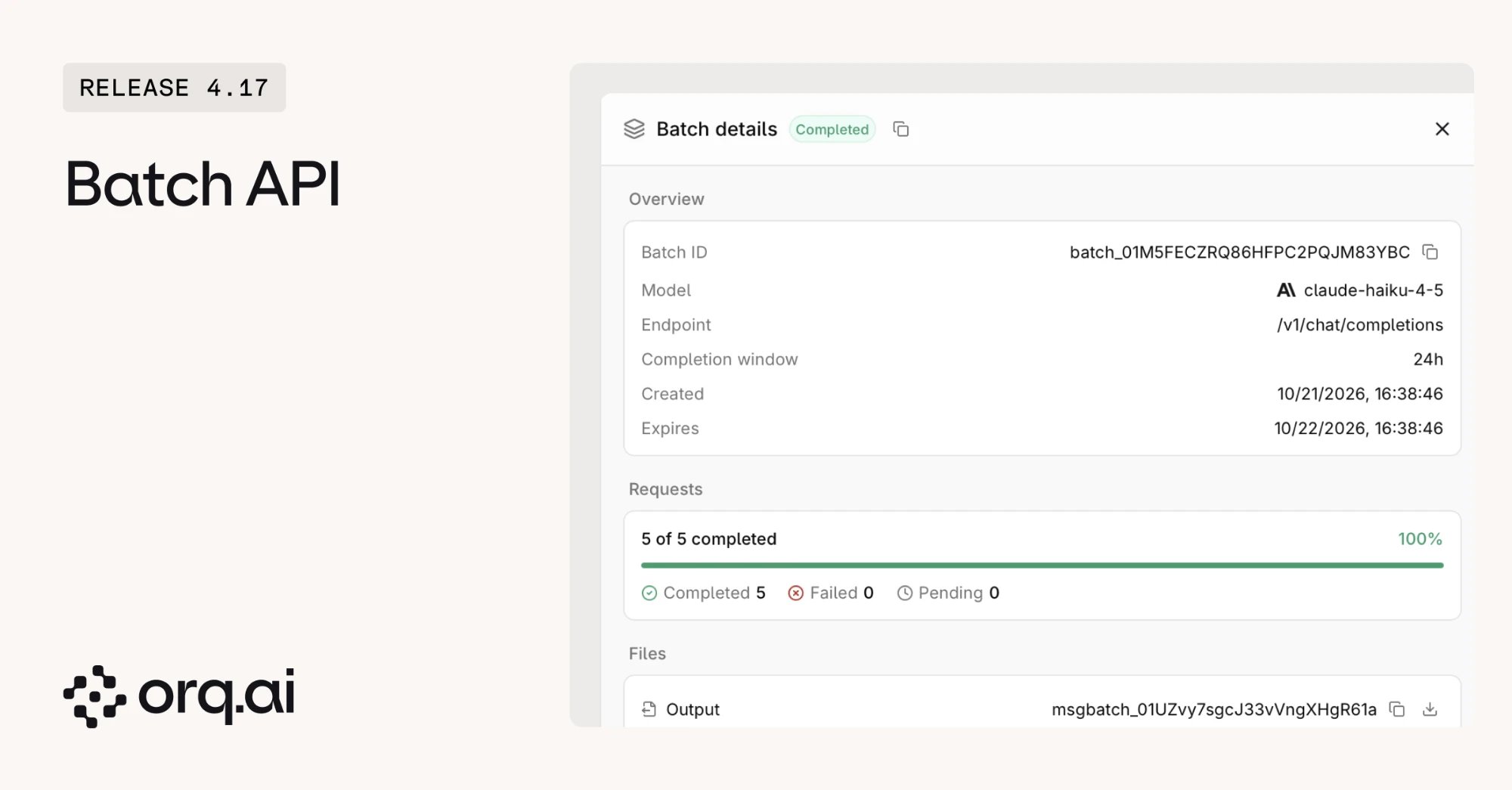
- Five providers: Run batches on OpenAI, Anthropic, AWS Bedrock, Google, and Mistral, or batch Decisions requests, which run on Orq.ai itself.
- One API and a Batches page: Create, list, and cancel batches under
/v3/router/batches, or upload a JSONL file on the Batches page and follow its progress there. Each batch counts as a single request against the workspace rate limit, and results come back in the OpenAI batch output format for every provider, with failed lines in a separate errors file. - Lower batch prices, tracked like any other call: Provider batches are billed at the provider’s batch rate, half the standard price for most models. Each finished batch appears in Traces with its summed tokens and cost, and counts toward usage, credits, and budgets.
Send a first batch with the Batches guide.
v4.17.0
Shape Studio around the way a team works. Every page opened in Studio becomes a tab in the top bar, and the sidebar shows only the sections a team uses, in the order it wants them.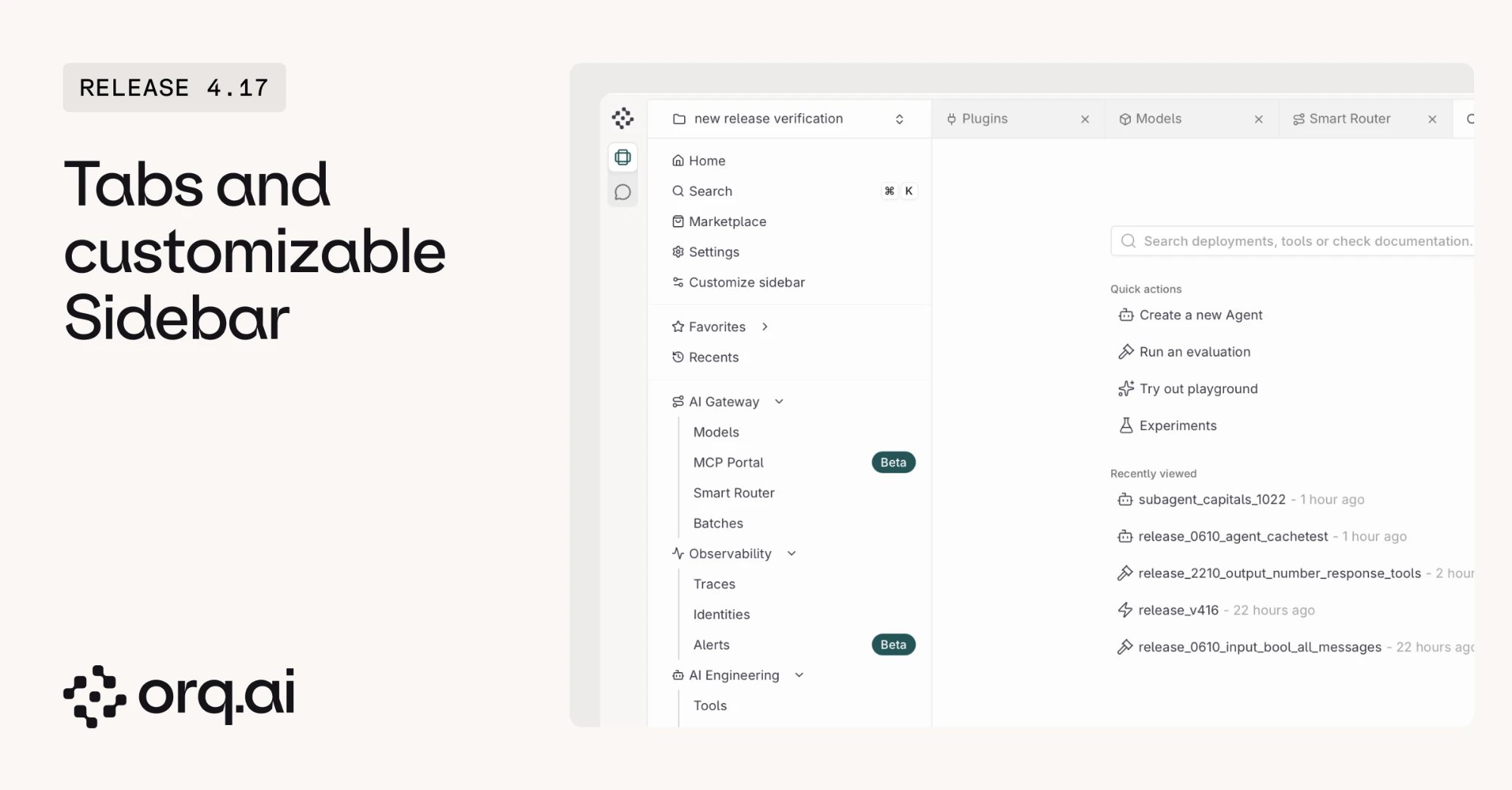
- Tabs that keep their state: Returning to an open tab shows the page exactly as it was left, with no reload, and open tabs carry across Projects. Tabs are on by default and can be turned off in the profile settings.
- A faster new tab: Search jumps straight to a page such as Settings or Traces, groups results by type, and offers quick actions to create an Agent, run an evaluation, or open the Playground.
- Customizable Sidebar: Open Customize sidebar below Settings to show or hide each page, switch whole sections on or off, and reorder sections with the arrows. The layout is saved per user and applies in every Project. Hidden pages stay reachable through
Cmd + K.
Learn more about Tabs and how to customize the sidebar.
v4.17.0
See why a run ended and what it cost at a glance. Traces now flag runs that were cut short, show the columns that matter by default, and zoom into any time window with a drag.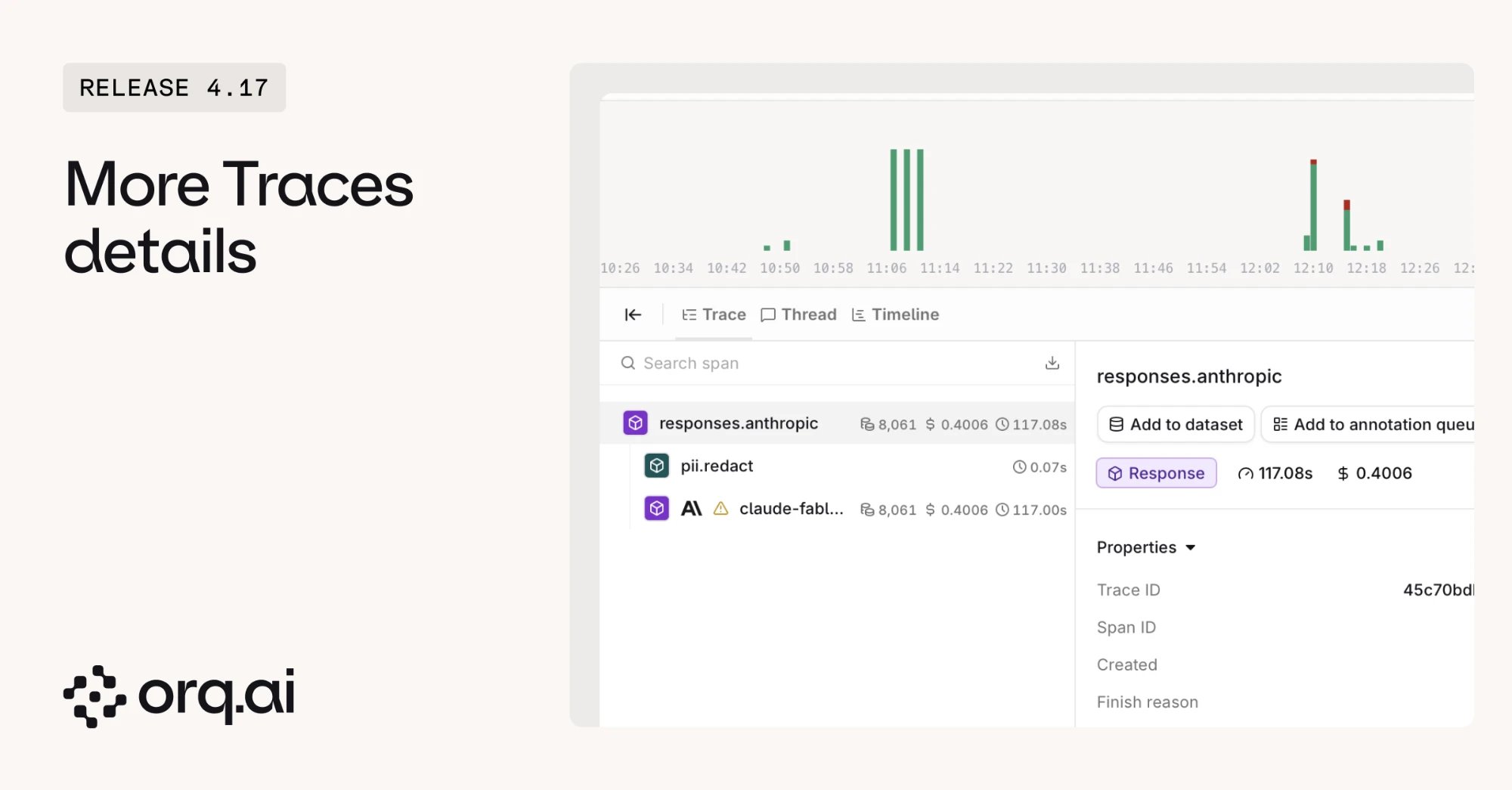
- Stop reason on LLM calls: A yellow warning marks a call that stopped on the output token limit, so a trace that looks successful but returned a short answer is easy to spot.
- Better default columns: Model, provider, cached tokens, Project, and a single Metadata column show by default. Token counts read as
12.4Kand costs keep a readable number of digits. - Drag to zoom: Drag across the activity chart to zoom into that time range. Logs get the same controls, with a Back button to undo a zoom.
Start with the Traces guide.
v4.17.0
- Model Fusion: Save a panel of models as one model, then call it through Chat Completions or Responses. Each request runs the panel, a judge compares the anonymized answers, and an optional synthesis step writes the final answer, with every step in Traces.
- Session affinity for the Smart Router: Keep every turn of a conversation on the model the Smart Router picked for its first turn, so the provider prompt cache survives. A later turn that turns out harder can still move up to a stronger model, never down. Turn it on per router and choose how long to pin, from 1 to 60 minutes.
- Agent Skills through the MCP Gateway: An MCP Gateway can serve workspace Skills and skills from linked MCP servers to any client that supports the MCP skills extension. Pick the skills per gateway in the new Skill set tab.
- Alerts on Metrics: Alert on runtime Metrics, including MCP telemetry, as well as on Traces. Thresholds show in the unit of the metric: percentages, milliseconds, or counts.
- Workload federation: Exchange an OIDC token from a CI pipeline or service, such as GitHub Actions, for a short-lived Orq.ai API key, so no Orq.ai secret is stored in the workload. Enterprise plan.
v4.17.0
- Traces on Deployments: Each Deployment has its own Traces tab, and filter fields in Traces and Logs are grouped, with the active Project shown.
- Annotations into Datasets: When a span is added to a Dataset, check Copy annotations to bring its human annotations along as named datapoint inputs.
- Variables on spans: Responses, Chat Completions, and Deployment spans record the request’s template variables in
orq.variables. Secret variables are left out, and nothing is recorded while PII redaction is active. - One Billing page: Credits and invoices now sit on a single page in Settings, with a clear split between them. Credits pay for model requests and stay in dollars. Agent runs, spans, storage and retention beyond the plan’s included volume, seats, and add-ons are invoiced monthly in euros, and the usage tiles show each meter against the plan.
v4.17.0
New additions to the Model Garden. Browse details on the Supported Models page.
v4.17.0
- Router and providers: The Responses endpoint honors
fallback_on_codes, Gemini truncation reportsfinish_reason: "length", Codex tool calls keep theirnamespace, and the Smart Router accepts custom AWS Bedrock models. - OpenTelemetry ingestion: The OpenAI Agents SDK instrumentor sends the user input, Vercel AI spans map to standard operation names, and synthetic OTLP traces keep model output, tool payloads, and Anthropic metadata.
- Traces: Text-to-speech spans store their audio, very large spans open without freezing the browser, Add to dataset keeps the system prompt, and the default view can be pinned again. Logs keep a 14-day range on reload.
- MCP Gateway: OAuth sign-ins stay valid for seven days, and PII redaction thresholds save for email and full-name entities.
- Deployments: Evaluator results show in Logs, image URLs passed as variables are recognized,
GET /v2/deploymentsrespects the sort order, and adding a variant from the Playground works again. - Experiments: Review mode no longer lags between responses, and uploaded images stay on the review page.
- AI Chat and Identities: Conversations with a reasoning answer load again, and Identity tags can be cleared.