

pii_redaction plugin modifies request and response content directly. It runs on every matching request without needing a separate rule condition.
Use cases
- Keeping names, emails, and account numbers out of third-party provider logs.
- Meeting data-handling requirements without rewriting prompts in every service.
- Sending sensitive support tickets to a model while preserving the reply for the end user.
- Excluding raw PII from trace storage while still tracing the request end to end.
pii_redaction plugin detects personally identifiable information in the request, replaces each value with a placeholder before the provider sees it, and restores the original values in the response. The provider receives only placeholders such as <EMAIL_ADDRESS_1> or <PERSON_2>.
This feature is in Beta.
Quick start
Add apii_redaction entry to the plugins array.
Workspace-level redaction
Enable PII redaction for every request from Settings > Plugins, without passing aplugins array on each call. Once enabled, the workspace plugin is merged into requests on the routes that run PII redaction, and a request cannot switch it off. On the other routes, request content reaches the provider unredacted.
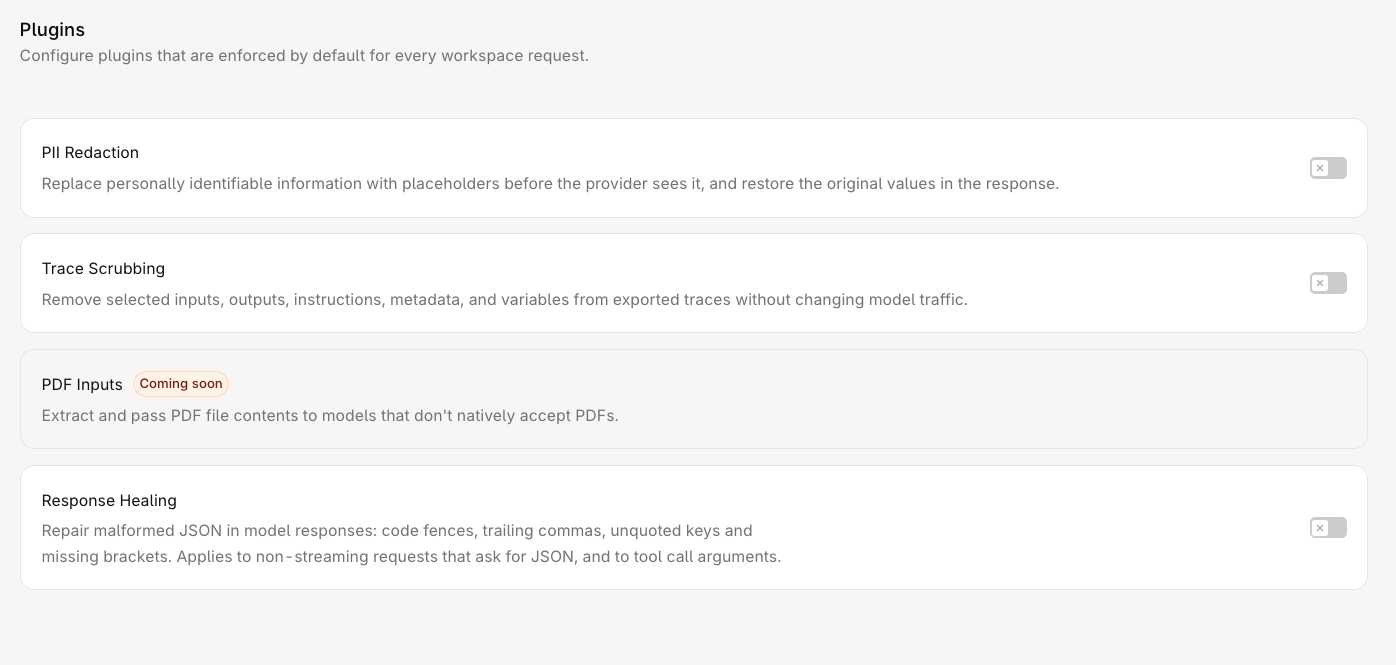
The Plugins settings page with enable toggles for PII Redaction, Trace Scrubbing, and Response Healing. PDF Inputs is marked Coming soon.
A request cannot switch the workspace redaction off.
Apply per routing rule
Attach apii_redaction entry to a Routing Rule to run redaction on the traffic that rule matches, with its own per-rule configuration.
How it works
The plugin runs a redaction round-trip around the generation:- Redact: detected PII in the request is replaced with typed placeholders before the request leaves the AI Gateway.
- Generate: the provider processes the placeholder text and returns a response that keeps the placeholders intact.
- Restore: the original values are substituted back into the response before it returns to the caller.
Routes that run the plugin
On the gateway routes outside this list, request content reaches the provider unredacted.
Detection runs on Orq.ai’s own model, hosted on Orq.ai infrastructure. Text is never sent to a third-party service for PII detection.
Configuration
GET /v2/pii/capabilities is the source of truth for the live entity catalog, the supported regions, the region-to-entity mapping (region_entities), the supported languages, and the default thresholds. The catalog grows with the service, so treat any list on this page as a snapshot rather than the full set.Detection threshold
Thethreshold parameter sets the global first-pass confidence score at which a detected value is counted as PII, and it applies to every type. The range is 0 to 1; the default is 0.5.
Scores are boosted for language-specific formats (for example, a Dutch BSN scores higher when the detected or selected language is Dutch). Adjust the threshold only when there is an observed problem: lower it if real PII is being missed, raise it if too many non-PII values are being redacted.
When
entity_thresholds names a type, that value replaces threshold for the type and may sit above or below it. A higher value detects less of that type, a lower value detects more, and types without an override stay at threshold.
Coverage selection
Coverage is selected two ways.regions covers whole regions: every entity type the listed regions gate is redacted, alongside the base catalog. entities is an explicit list of entity types to redact, and on its own it is strict — nothing outside the list is redacted. Set both and the two are unioned: the region coverage plus the named types, so entities widens rather than narrows. Omit both and every region is redacted: selecting nothing is the widest request, not the narrowest. That default is gated on entities being empty, so it can never loosen an allowlist — entities alone stays strict.
Regions
Region codes are lowercase ISO 3166-1 alpha-2, for examplenl, gb, be, de, fr, and us. The United Kingdom is gb, never uk. The value ["all"] is exclusive: it covers every supported region and cannot be combined with other region codes. Read the live set of supported regions and the types each one gates from GET /v2/pii/capabilities.
Regions
Entity types
Entity type names are UPPERCASE, for examplePERSON, EMAIL_ADDRESS, and BSN. A named region-specific type fires even without naming its region, so the types belonging to a region can be picked individually instead of taking the whole region.
Per-entity thresholds
entity_thresholds maps an entity type to a confidence cutoff in [0,1]. It only tunes confidence; it never changes which types are redacted. Every key must also appear in entities: a key that is absent from entities, or any key at all while entities is empty, is rejected with a validation error.
Per-entity tuning applies to the types named in entities. To tune a type a region gates, name that type in entities — alongside regions if the rest of the region should stay covered — and set its cutoff. region_entities from GET /v2/pii/capabilities lists the types each region gates.
Entity types with per-entity thresholds
Failure modes
Theon_failure policy decides what happens when the detection service cannot run:
The detection service waits up to 90 seconds by default before timing out and applying the
on_failure policy.
The guardrail is always fail-closed
on_failure belongs to the pii_redaction plugin only. The orq_pii_detection guardrail always fails closed: if the detection service is unavailable or the detect call errors, the text is treated as containing PII and the request is blocked. There is no way to make a guardrail fail open, and setting on_failure in a guardrail’s options is rejected at write time rather than silently ignored: a safety control whose stored configuration disagrees with what it does is worse than one with no setting at all. Use the plugin when you need configurable failure behavior.
One consequence is worth knowing before an incident rather than during one: a guardrail rule with no project and no expression applies workspace-wide, because project-less rules are indexed as globals and an empty expression matches every request. A detection service outage therefore blocks all /responses, /chat/completions and /messages traffic in that workspace. That is the intended fail-closed behavior, not a defect, but it means a workspace-wide PII guardrail couples inference availability to the availability of the detection service.
Supported entity types
GET /v2/pii/capabilities is the live catalog and the only authoritative list: it grows with the detector, and languages, base_entities, all_entities, regions and region_entities all come from it. The lists below are a snapshot for orientation.
Base entity types need no region: they are detected whenever regions is set. Setting neither regions nor entities covers every region, base types included. Regional types are detected when their region is selected, or when the type is named in entities. With entities alone nothing is detected but the named types, base types included.
The base list is what the catalog classifies as region-independent, not what a given detector build emits in practice. Several of these types have narrower recognizers than the catalog entry suggests, so probe the detector before relying on a specific type firing with no configuration.
Base (every region)
Base (every region)
AGE, API_KEY, BANK_ROUTING, BIC, BIOMETRIC_ID, BLOOD_TYPE,
CREDIT_CARD, CRYPTO, DATE_TIME, DEVICE_ID, EDUCATION_LEVEL,
EMAIL_ADDRESS, EMPLOYMENT_STATUS, GENDER, HEALTH_PLAN_ID,
HTTP_COOKIE, IBAN_CODE, ID, IMEI, IP_ADDRESS,
JOB_TITLE, JWT, LANGUAGE, LICENSE_NUMBER, LICENSE_PLATE,
LOCATION, MAC_ADDRESS, MEDICAL_RECORD, NRP, ORGANIZATION,
PASSPORT, PASSWORD, PERSON, PHONE_NUMBER, PIN,
POLITICAL_VIEW, RACE_ETHNICITY, RELIGIOUS_BELIEF, SEXUALITY,
TAX_ID, URL, UUID, VEHICLE_IDBelgium (be)
Belgium (be)
BE_ENTERPRISE_NUMBER, BE_NATIONAL_NUMBERGermany (de)
Germany (de)
DE_TAX_ID, DE_VAT_NUMBERFrance (fr)
France (fr)
FR_INSEE, FR_SIRENUnited Kingdom (gb)
United Kingdom (gb)
GB_NHS, GB_NINONetherlands (nl)
Netherlands (nl)
BSN, KVK_NUMBER, NL_DRIVER_LICENSE, NL_ONDERWIJSNUMMER,
NL_PAYROLL_TAX_ID, NL_RSINUnited States (us)
United States (us)
MEDICAL_LICENSE, US_BANK_NUMBER, US_DRIVER_LICENSE, US_ITIN,
US_PASSPORT, US_SSNEntity type names that changed
These keys were renamed or dropped. A request that names an old key is rejected. Stored PII settings (workspace defaults, routing and guardrail rules, MCP gateways,orq_pii_detection guardrails) that still carry one are read as the replacement. Save them with the new key; the dashboard does this for you when you open and save the settings:
JOBTITLE, UK_NHS and TITLE changed when the catalog became region-scoped. ID_CARD is merged into ID; the two names described the same thing. Identity card numbers are still redacted, but they come back as ID. If a client reads entity_type or placeholder names such as <ID_CARD_1> from responses, match on ID instead. ID also covers other identifiers such as customer and employee numbers, so a saved selection of only ID_CARD now redacts those too. A saved ID_CARD threshold is kept only when ID has its own, and then the lower of the two applies; on its own it is dropped, so ID uses the default threshold rather than a floor set for identity cards alone.
The US types keep their names but are now gated by the us region rather than by language: en, so a config that relied on English selecting them needs regions: ["us"] or an explicit entities list.
Tracing
Redaction is traced in-process as child spans of the request:pii-redact for the input pass and pii-restore for the output pass. Each span carries the configured language, the failure policy, the requested entity count, the placeholder count, and the outcome. persist_redacted_to_traces controls whether the redacted (placeholder) form or the restored original is stored in trace content; it defaults to true (redacted form stored).