Orq MCP is live: Use natural language to interrogate traces, spot regressions, and experiment your way to optimal AI configurations. Available in Claude Desktop, Claude Code, Cursor, and more. Start now →
API Keys are secure tokens used to authenticate requests to Orq.ai. Each key is scoped to a single project and carries a set of permissions that control what it can do.Two key types are available, chosen by the key’s owner.
Tied to a specific user account and project. Automatically revoked if the user is removed from the organization or project. Use user keys for personal use and local development.
Not tied to any individual user, with a lifecycle independent of user membership. Only workspace admins can create service account keys. Use service account keys for production systems, so access does not break when a team member leaves.
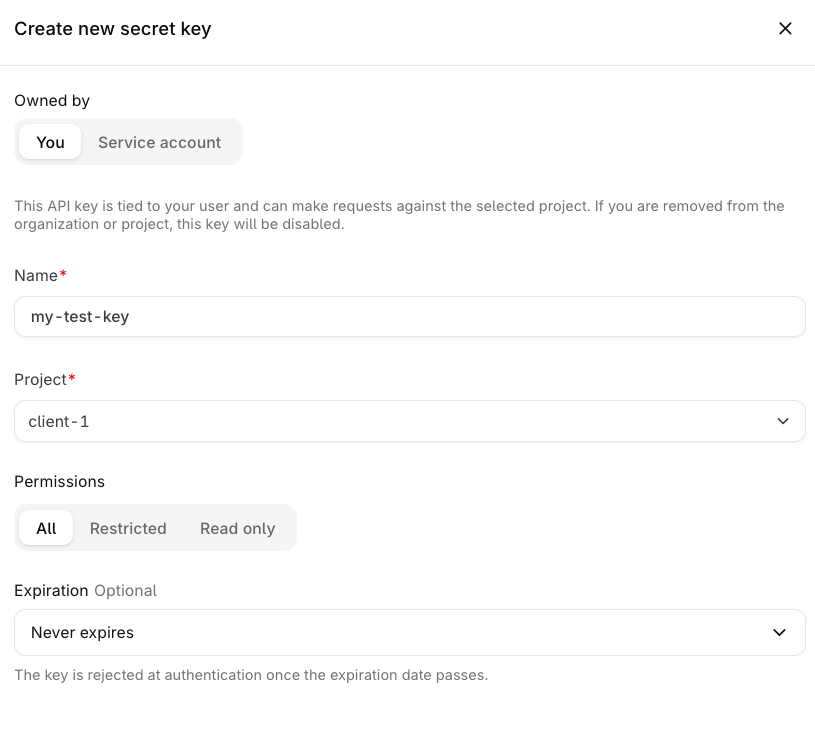
Navigate to Settings > API Keys and select Create API key.
The API key creation panel.
2
Choose an owner
Select You to create a User key, or Service account to create a key not tied to any individual user.
3
Set name and project
Enter a Name for the key and select the Project it will have access to.
4
Set permissions
Choose a permission preset. See Permissions below.
5
Set expiration (optional)
Set an Expiration date if the key should automatically become inactive after a certain date.
6
Create and copy the key
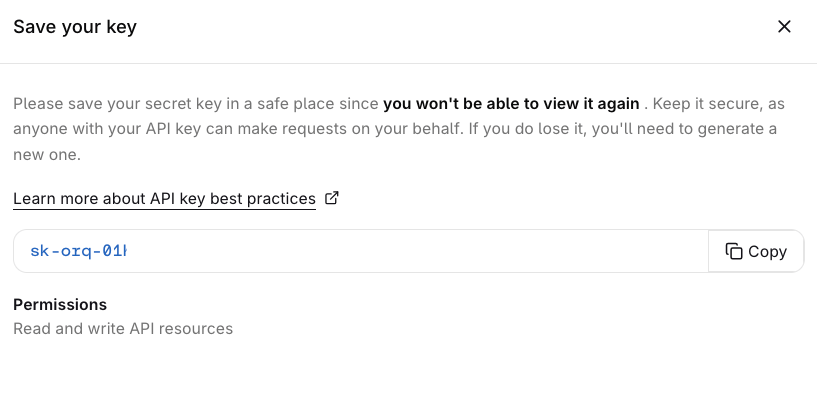
Select Create API key. A Save your key dialog appears showing the token and its permissions summary.
The Save your key dialog appears once after creation.
Click Copy to copy the token.
The token is only shown once. Store it securely before closing this dialog. It cannot be retrieved afterwards.
To cap a key’s cost, token, or requests-per-minute usage, attach a Budget to it. Budget limits reset on the configured period. See Rate limits & quotas for what the gateway enforces at each layer.
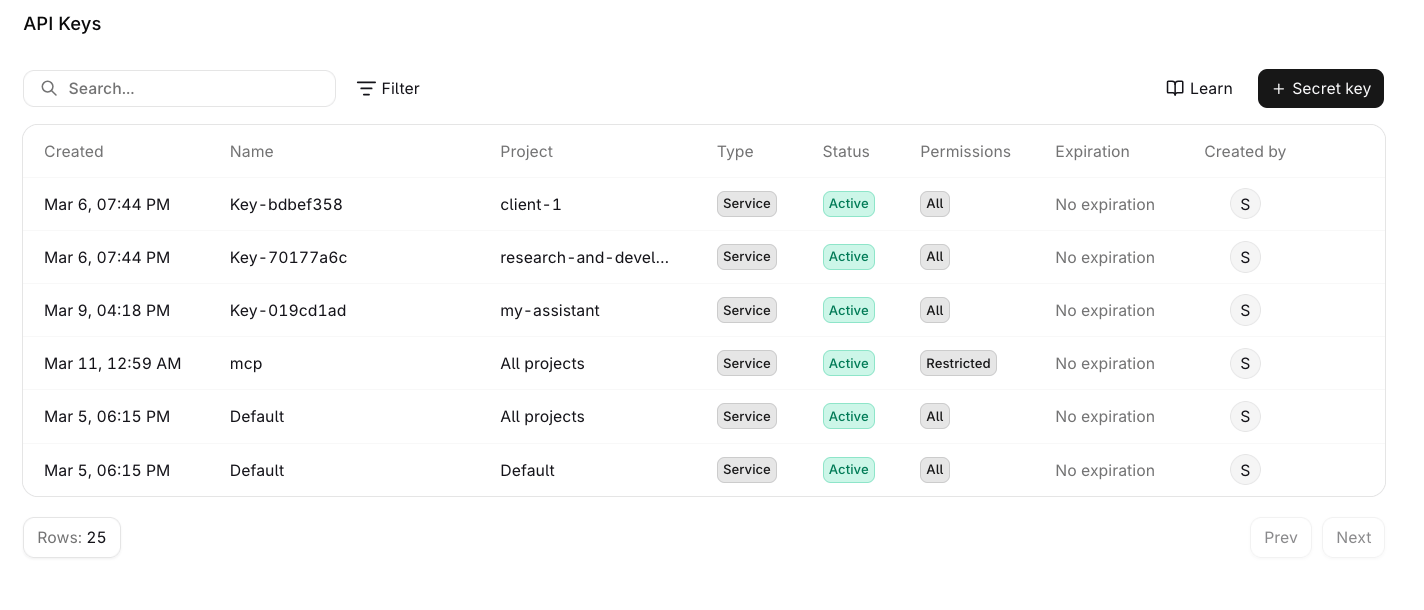
The API Keys management table showing all keys, their type, status, permissions, and actions.
Select the menu on any key to access the following actions:
Edit: update the name, permissions, or expiration date. The owner type cannot be changed after creation.
Duplicate: opens the creation panel pre-filled with the key’s current settings.
Delete: permanently removes the key. This cannot be undone.
A Revoked status means the key belonged to a user who was removed from the organization or project, or it has been revoked manually. Revocation is permanent.
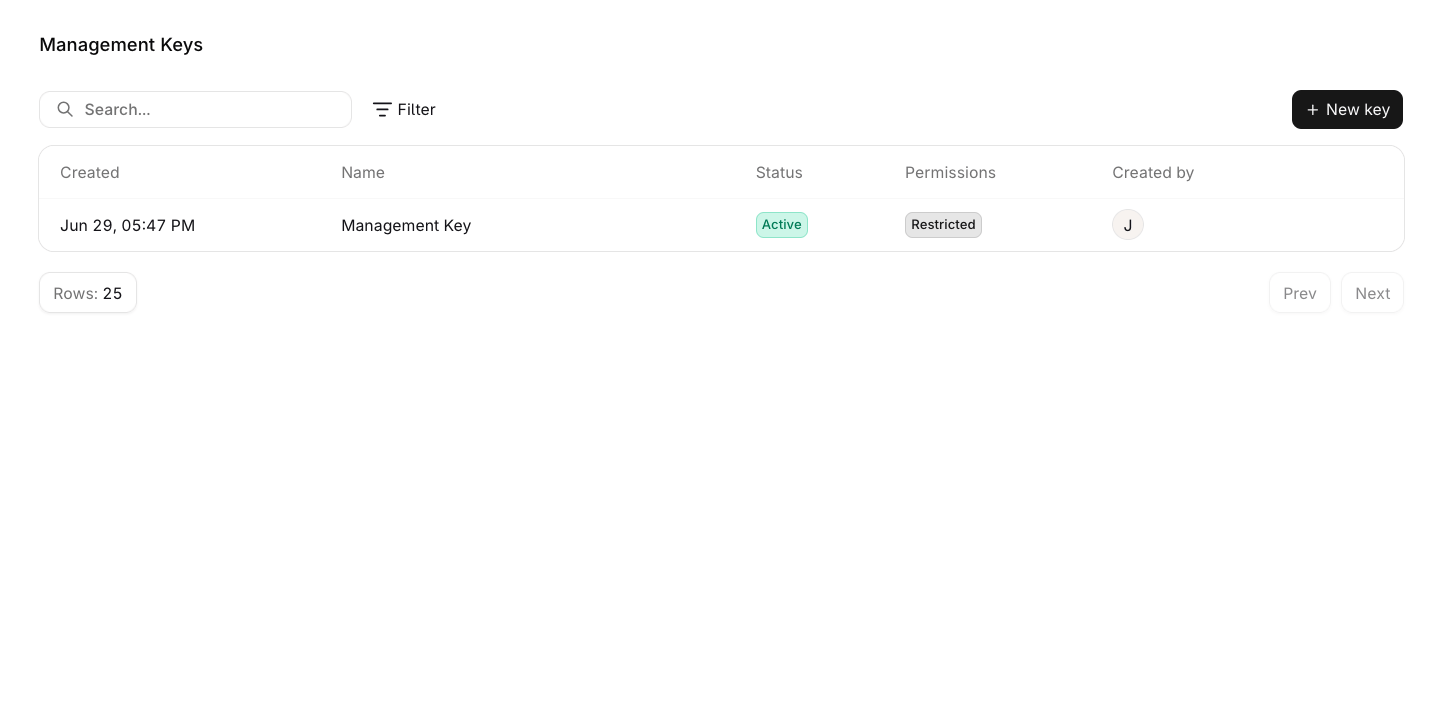
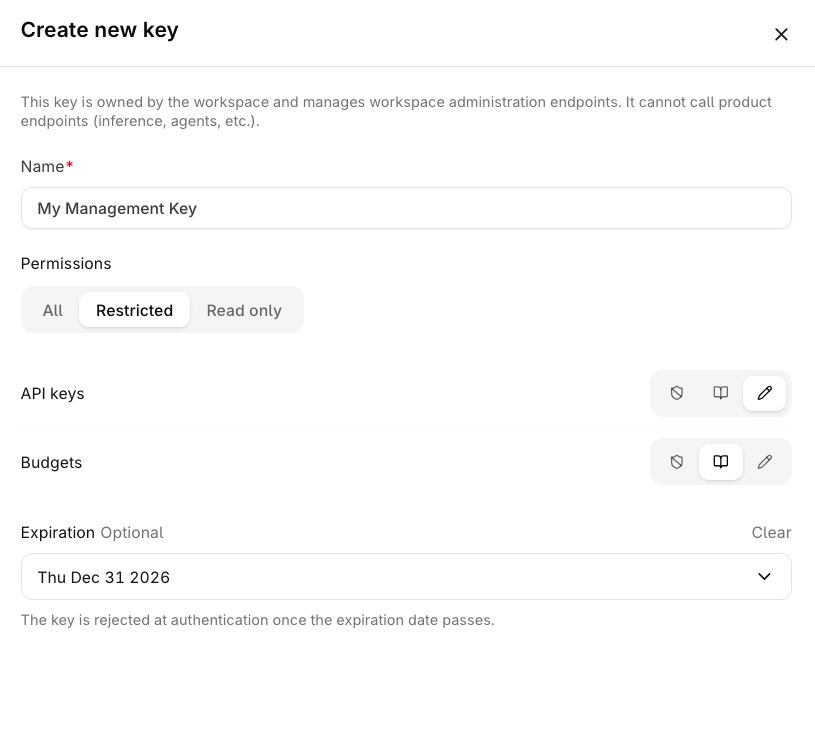
Management Keys are only available to workspace admins. The Management Keys page is not visible to non-admin members.
Management Keys are workspace-scoped tokens for authenticating workspace administration operations. They can manage API keys, Budgets, Projects, Smart Routers, Evaluators, Workspace models, and Workspace Settings.
Management Keys cannot be used to query models or agents. Use a standard API Key for inference and product endpoints.
Standard API keys are project-scoped. Use a Management Key for these workspace administration endpoints:
Endpoint family
Management Key access
/v2/api-keys*
List, retrieve, create, update, and delete API keys. /v2/api-keys/capabilities is public.
/v2/budgets*
List, retrieve, create, update, reset, and delete Budgets. /v2/budgets/check accepts a project-scoped API key.
/v2/projects*
Manage Projects across the workspace. A project-scoped API key can only list or retrieve its selected Project.
/v2/smart-routers*
List, retrieve, create, update, enable, disable, and delete Smart Routers.
Notifiers are intentionally not listed here: their routes are project-scoped and do not require a Management Key. Project-scoped API keys can access the Notifiers API for their selected project.
Key management requests authenticate with a Management Key, never an API key. API Keys are project-scoped inference credentials and cannot administer keys.
Pass a Management Key as the bearer token, or as the SDK API key.
A Management Key with the api-key write grant can list, create, update, revoke, and delete API Keys.
Managing Management Keys requires the management-key grant, which is not part of the All or Read only presets. Grant it explicitly to a Management Key that must administer other Management Keys.
The SDK exposes these operations as api_keys / apiKeys and management_keys / managementKeys: API Keys SDK, Management Keys SDK.
To rotate a key, create a replacement key with the same configuration, then revoke the old one. Rotation is create followed by revoke; there is no dedicated rotate endpoint.
Read and write access to all domains in the API key capability catalog
PERMISSION_MODE_READ_ONLY
Read access to all domains in the API key capability catalog
PERMISSION_MODE_RESTRICTED
Per-domain access via the access map
With PERMISSION_MODE_RESTRICTED, the access map assigns a level to each domain: ACCESS_LEVEL_NONE, ACCESS_LEVEL_READ, or ACCESS_LEVEL_WRITE. Write includes read. REST JSON and the SDKs accept the enum names:
Level
Access
ACCESS_LEVEL_NONE
No access
ACCESS_LEVEL_READ
Read access
ACCESS_LEVEL_WRITE
Read and write access
The capability catalog lists the domains a key can be granted: GET /v2/api-keys/capabilities returns each domain with its id, display name, group, and read / write availability. Use the catalog to discover grantable domains at runtime instead of hard-coding the list.
The create response returns the raw token exactly once, in the sk-orq-<id>-<secret> format. Store it immediately: the API stores only a displayable token_prefix and a hash of the secret, so list and retrieve responses never include the token.
The token is only returned in the create response. Store it securely and treat it like a password; it cannot be retrieved afterwards.
Keys do not carry limit fields. Attach cost, token, and requests-per-minute limits with a Budget scoped to the key.Budgets are workspace resources and require a Management Key; regular API Keys cannot manage them.